

PROTECT YOURSELF with Orgo-Life® QUANTUM TECHNOLOGY
Orgo-Life the new way to the future Advertising by Adpathway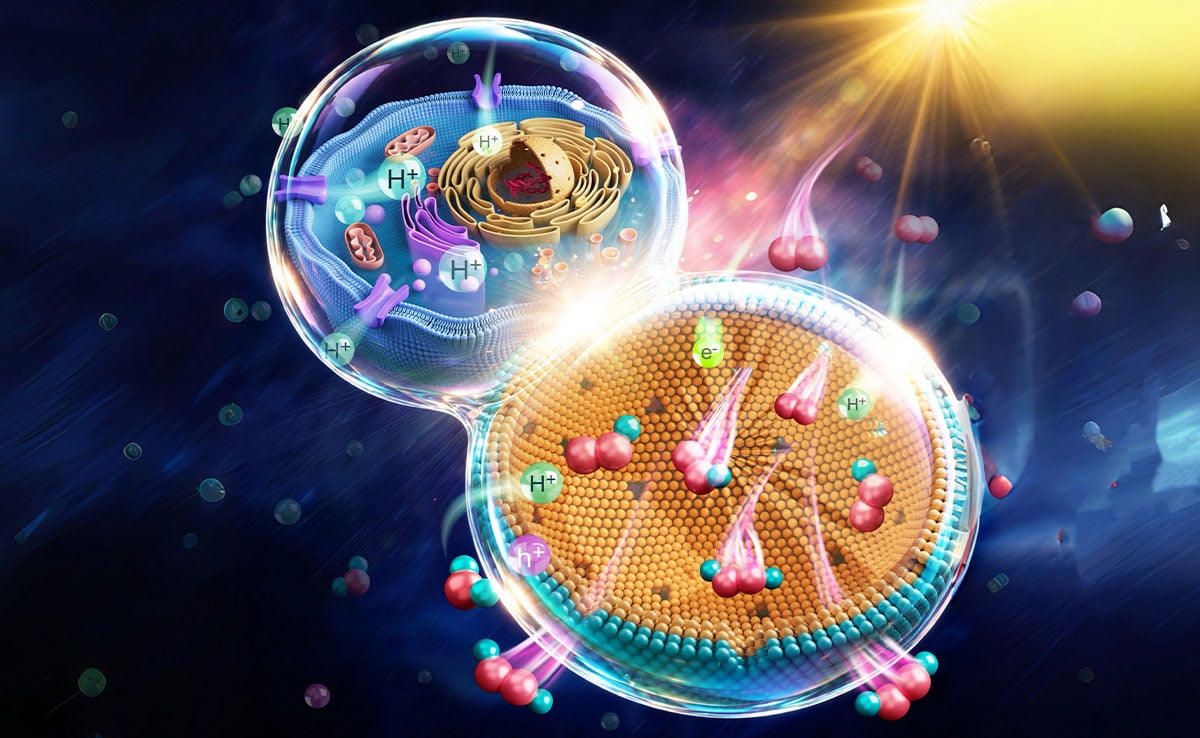 Nanoreactor mimics living cells for enhanced artificial photosynthesis. Credit: JACS
A biomimetic nanoreactor combines cellular design principles to produce hydrogen peroxide efficiently under visible light.
Inside a hollow nanoscale structure, researchers have recreated two strategies that living cells use to control chemical reactions. The resulting CdS@polydopamine nanoreactor offers a synthetic way to reproduce some of the organization and efficiency found in biological systems.
The work was published in the Journal of the American Chemical Society. Can Li of the Dalian Institute of Chemical Physics (DICP), part of the Chinese Academy of Sciences (CAS), led the research with Jian Liu’s group at Inner Mongolia University.
Cells organize biochemical reactions through confined, multilevel structures whose components occupy carefully arranged locations. Nanocell engineering applies similar principles to artificial materials by creating cell-like nanoreactors with specialized surfaces and separate pores or cavities. This approach brings cellular biology and nanotechnology together to control reactions within extremely small spaces.
Two cell-inspired features work together
The hollow nanoreactor combines two biomimetic functions. The first comes from a dynamic catechol/o-benzoquinone redox pair within its polydopamine shell. Rather than actively pumping protons, this pair acts as a relay that repeatedly accepts and donates them, accelerating proton-coupled electron transfer (PCET).
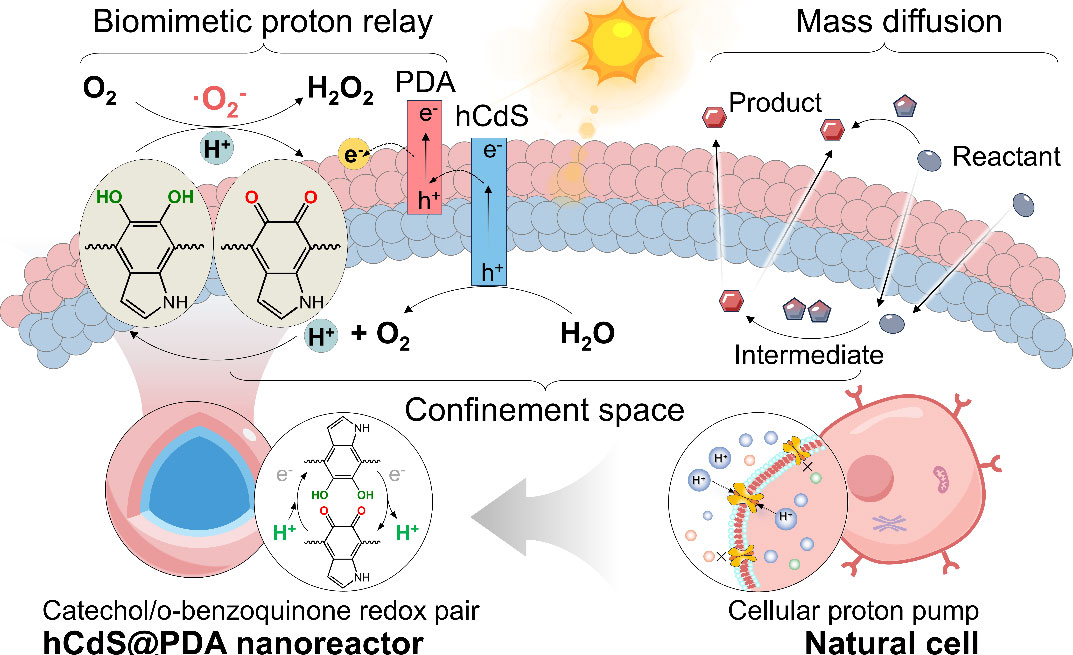 Schematic illustration of photocatalytic H2O2 synthesis over hollow CdS@polydopamine based on biomimetic proton relay machinery and nanoreactor engineering. Credit: Li Haitao
The second feature is the nanoreactor’s compartmentalized structure. A porous outer shell surrounds a nanoscale cavity, creating a confined environment that supports reactant enrichment, mass diffusion, and photon trapping.
Working together, these properties help balance the different reaction speeds of oxygen reduction and water oxidation. Under visible-light illumination in an aqueous solution, the system achieved an H2O2 photosynthesis rate of 3.24 mmol gcat.-1 h-1 and a solar-to-chemical conversion efficiency of 1.2%.
Hydrogel design enables sunlight reuse
The researchers combined in situ spectroscopy, photochemical measurements, finite element simulations, and theoretical calculations to examine how the nanoreactor functions. Their analysis revealed the biomimetic process and clarified the photocatalytic mechanism based on a Z-scheme heterojunction.
They also enclosed the material within an environmentally benign sodium alginate hydrogel. This produced solid, recyclable photocatalysts capable of maintaining stable H2O2 synthesis under natural sunlight.
“Our study provides a new strategy for engineering biomimetic nanoreactors that increasingly replicate the sophisticated functions of living cells, opening new opportunities in artificial photosynthesis, energy catalysis, and synthetic chemistry,” said Prof. Li.
Reference: “Biomimetic Redox-Mediated Proton Relay in Nanoreactors for Photocatalysis” by Haitao Li, Mengyuan Ji, Jinlu He, Dehui Deng, Jincai Zhao, Jian Liu and Can Li, 8 July 2026, Journal of the American Chemical Society.
DOI: 10.1021/jacs.6c08170
Never miss a breakthrough: Join the SciTechDaily newsletter.
Follow us on Google and Google News.


















 English (US) ·
  French (CA) ·
  French (FR) ·