

PROTECT YOURSELF with Orgo-Life® QUANTUM TECHNOLOGY
Orgo-Life the new way to the future Advertising by Adpathway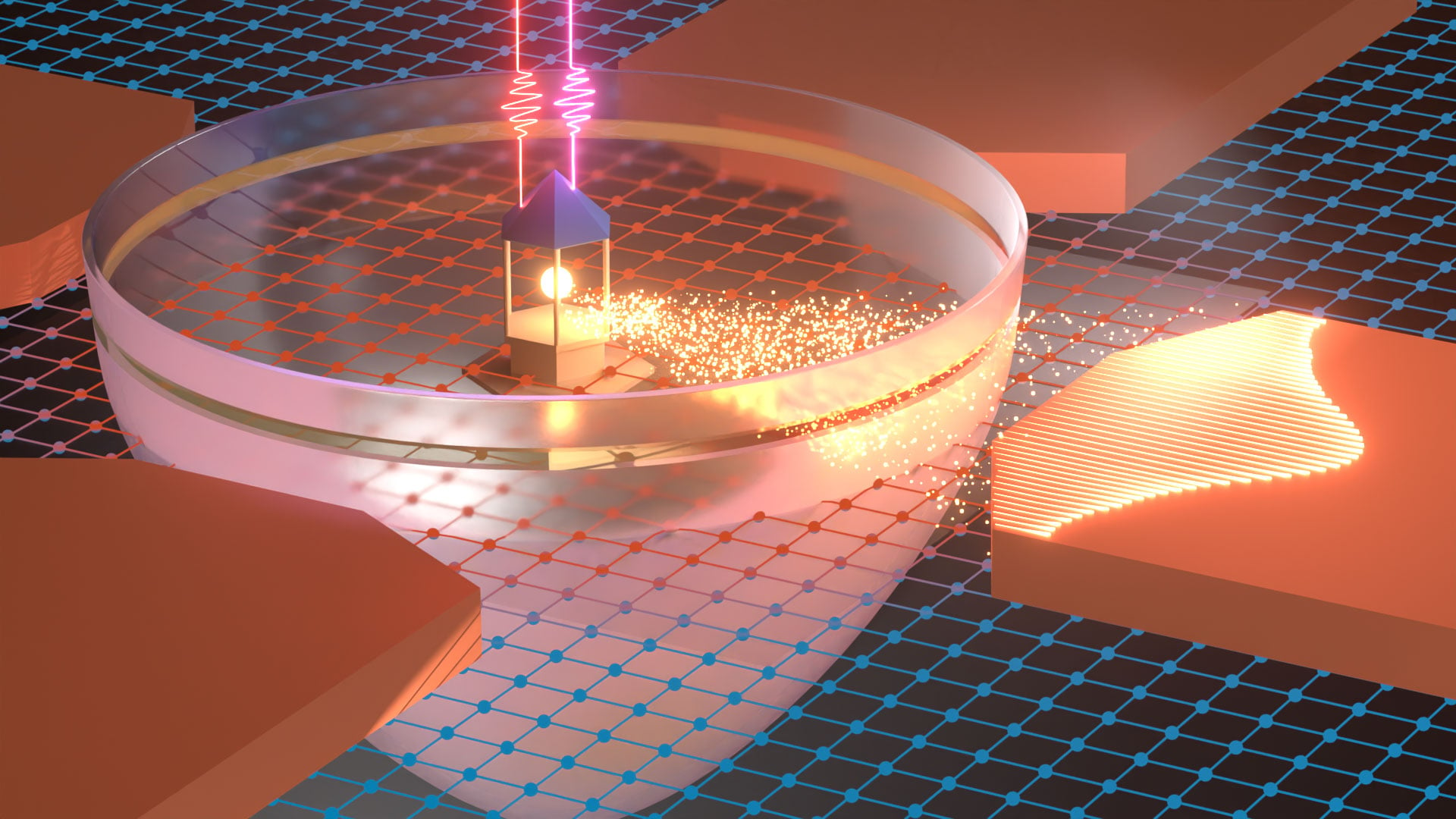 When two pulses of different colored lasers (the two waves at the top of the image) light meet in a new device created at the University of Michigan, researchers create a beam of electrons (small golden particles) that flows in a controllable direction. By changing the laser colors, the electron beam can sweep through different directions like the beam of a lighthouse. Credit: Yiming Gong
The light-controlled electron current could open new paths for sensing, telecommunications, and other advanced technologies.
A pair of laser beams can now send electrons through a semiconductor in a chosen direction without any external electrical power. Researchers at the University of Michigan built the device to explore a previously unobserved physical effect and demonstrate that light alone can both generate and steer an electronic current.
The work could eventually support technologies that combine optics and electronics, including sensing, imaging, and telecommunications. By improving how signals move within and between devices, the effect may also allow those signals to carry more information.
“This electrical device that we manufactured at the Lurie Nanofabrication Facility has the potential to turn into something that measures different aspects of light,” said Yiming Gong, who helped lead the project as a doctoral student in the U-M Department of Physics. “But this originates from a very fundamental level of physics, which is the interference between different optical absorption processes.”
Two colors steer electrons without voltage
With support from the U.S. National Science Foundation, the researchers used two colors of light to produce an organized flow of electrons through a semiconductor. They could also change the direction of that current by rotating the polarization of the two optical fields, meaning the direction in which the light waves oscillate.
“This isn’t the way things normally work. When you think about electrons moving through a material, they’re moving because you’ve applied an electrical field and they actually bounce around and drift across the materials. Here, using light, you can actually sort of squirt the electrons in a specific direction without applying an electric field,” said U-M physicist Steven Cundiff, senior author of the team’s new report in the journal Physical Review Letters.
Earlier experiments had already shown that light could generate an electron current without an applied electric field. The new device goes further by concentrating those electrons into a narrow stream and directing them along a selected path.
“The light no longer merely switches the current on; it also aims it,” Cundiff said.
Cundiff compares the effect to a lighthouse that rotates its lamp to sweep a beam across the horizon. In this case, the beam consists of electrons, and its direction changes when the polarization of the two phase-coherent optical fields is rotated.
Quantum interference directs the current
The effect depends on quantum interference, which occurs when two colors of light create separate absorption pathways leading to the same final state. The semiconductor absorbs energy from the light in discrete packets called photons, which set its electrical charge carriers in motion.
In the U-M setup, the material absorbs the incoming light through both routes simultaneously. Cundiff described the pathways as overlapping ripples. For electrons traveling in one direction, the ripples align and reinforce each other. For electrons moving in other directions, they cancel each other out.
A predicted effect becomes a device
J.E. Sipe of the University of Toronto, who collaborated on an earlier project, had predicted that such an “electron lighthouse” could be created. Working with the Lurie Nanofabrication Facility, Gong was able to turn that prediction into a functioning device.
“The LNF is an amazing facility,” Gong said, adding it was a painstaking process to meld the device’s materials together in a way that didn’t introduce any extraneous electric fields.
“That was the biggest puzzle to solve for me, because there isn’t a standard way to do that. So I worked with the LNF staff to play around with different recipes and temperatures to come up with a manufacturing process.”
Reference: “Directional Photocurrent Generated by Quantum Interference Control” by Yiming Gong, Kai Wang and Steven T. Cundiff, 16 July 2026, Physical Review Letters.
DOI: 10.1103/3v91-5pzf
Federal support from the U.S. National Science Foundation
Never miss a breakthrough: Join the SciTechDaily newsletter.
Follow us on Google and Google News.
























 English (US) ·
  French (CA) ·
  French (FR) ·