

 1 month ago
19
1 month ago
19
PROTECT YOURSELF with Orgo-Life® QUANTUM TECHNOLOGY
Orgo-Life the new way to the future Advertising by Adpathway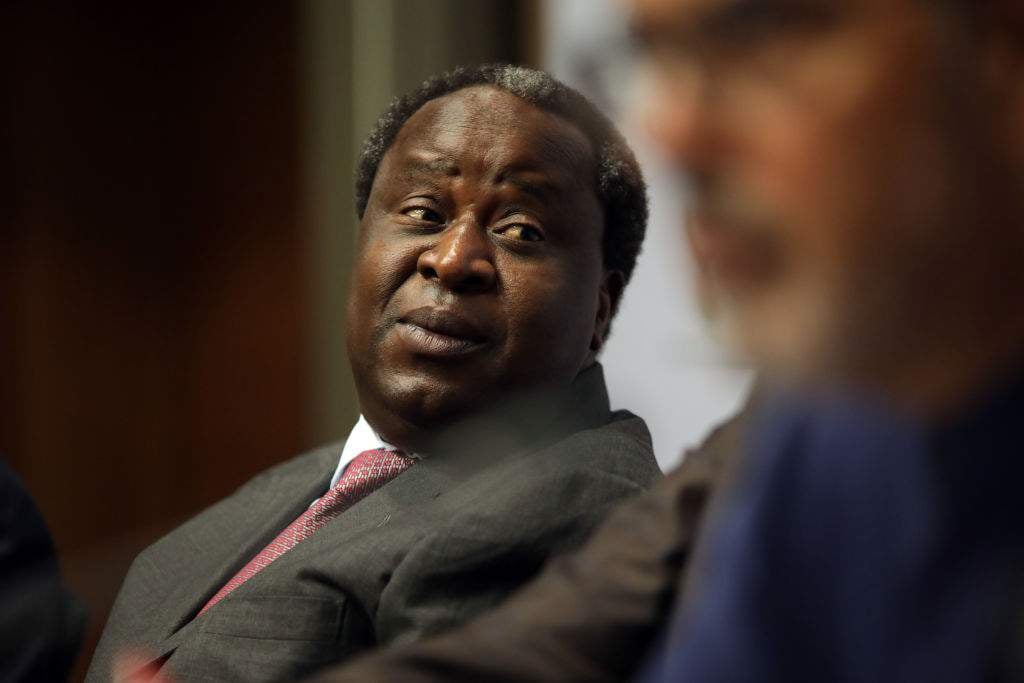
The late Dr Tito Mboweni, the eighth Governor of the SA Reserve Bank, in 2020, when he was Minister of Finance.
Dwayne Senior/Bloomberg via Getty Images
At the inaugural Tito Mboweni Memorial Lecture, global central bankers paid tribute to his public service, emphasising that his push for stronger global institutions matters now more than ever, writes Hanlie Nordejee.
- For more financial news, visit News24 Business.
The role of the late Tito Mboweni in securing the SA Reserve Bank’s (SARB) independence — now so entrenched it seems untouchable — was celebrated by central bankers at an event on Thursday.
Beyond shielding the bank from political interference, they say Mboweni also introduced more transparent and predictable monetary policy decisions, making the institution more accountable to South Africans.
Credit for SA’s inflation-targeting regime, which was first introduced in 2000, was also given to Mboweni, who served as SARB governor from 1999 to 2009.
Mboweni’s contribution as a “key architect” of SA’s financial infrastructure was lauded on Thursday at the first Tito Mboweni Memorial Lecture held in Cape Town. Mboweni died on 12 October 2024, having served as Minister of Labour (1994-99), SARB Governor (1999-2009), and Minister of Finance (2018-21), with a stint as farmer and businessman in between. Mboweni jokingly gave himself another title: Duke of Makgobaskloof.
The inaugural lecture was given by Prof Axel Weber, president of the Centre for Financial Studies at Goethe University Frankfurt and former Deutsche Bundesbank President (2004-11) and focused on global imbalances.
Weber looked at the increasing geopolitical fragmentation and the need for stronger policy coordination globally to counter its effects. Mboweni himself had emphasised the need for strong international structures, Weber said.
The discussion after the lecture included Jacob Frenkel, chairman emeritus of the Group of 30 and former Governor of the Bank of Israel (1991-2000), and Guillermo Ortiz, treasurer of the G30 and former Governor of the Banco de México (1998-2009).
Their terms as central bankers all overlapped with Mboweni’s, and they worked together at the Bank for International Settlements (BIS). His role in raising issues affecting emerging countries was a thread throughout, and especially relevant in the era of global trade tensions.
Weber praised Mboweni’s intellectual rigour, but also his humour, noting that conversations following BIS meetings in Basel, Switzerland, always took place over a cigar.
Introducing Weber, current SARB Governor Lesetja Kganyago lauded Mboweni as a “giant in the world of policy and a close friend that I miss dearly.”
Risks of fragmentation
While never mentioning US President Donald Trump by name, Weber lambasted “protectionism disguised as protecting national interests”. He said the US emphasis on correcting trade imbalances was misplaced and measured only goods trade, neglecting to add the massive value of US digital services exports.
Trade tariffs did lead to a drop in Chinese exports to the US, but China has merely diversified its exports, rerouting to other countries.
Weber also said that trade deficits were, in many cases, the result of strategic decisions by corporations – for instance, US pharmaceutical companies holding patents in Ireland for its tax benefits, or outsourcing production, leading to imports into the US by US companies. These deficits cannot be corrected with tariffs.
“Imbalances should be addressed by all countries simultaneously,” he said, saying countries should “stop pointing fingers”.
The answer lay not with unilateral decisions but with working through international structures, like the International Monetary Fund, Organisation for Economic Cooperation and Development and Financial Stability Board.
“If major powers fail to cooperate, smaller economies bear the cost,” he said, citing capital flight, high inflation and eventually social unrest.
Frenkel elaborated on the theme, saying: “In a world where the philosophy is an eye for an eye, there are a lot of blind people.”
He added: “Fragmentation does not reduce interdependence.”
Ortiz also said, “tariffs don’t close trade imbalances”. It is “the wrong instrument, for the wrong purposes”.
Ortiz said Tito understood that international institutions were absolutely fundamental, but needed the feedback of emerging markets.
In the words of Weber: “Dr Mboweni may no longer be with us, but his voice can still be heard, and his example continues to speak to generations to come.”
The event was closed by a speech by Fumani Mthembi, a niece of Mboweni, who honoured him for his critical thinking. Looking back at the achievements of the first democratic SA government – for instance, the rapid electrification of millions of homes and the building of thousands of clinics – she said there was a “moral imperative to deliver infrastructure” that will lead to economic growth.
She said her “Uncle T” had taught her: “Our commitment is not to the right or the left, the east of the west – but to the path leading to a just society.”
It was time to “reimagine our path towards justice and equality.”


















 English (US) ·
  French (CA) ·
  French (FR) ·