

PROTECT YOURSELF with Orgo-Life® QUANTUM TECHNOLOGY
Orgo-Life the new way to the future Advertising by Adpathway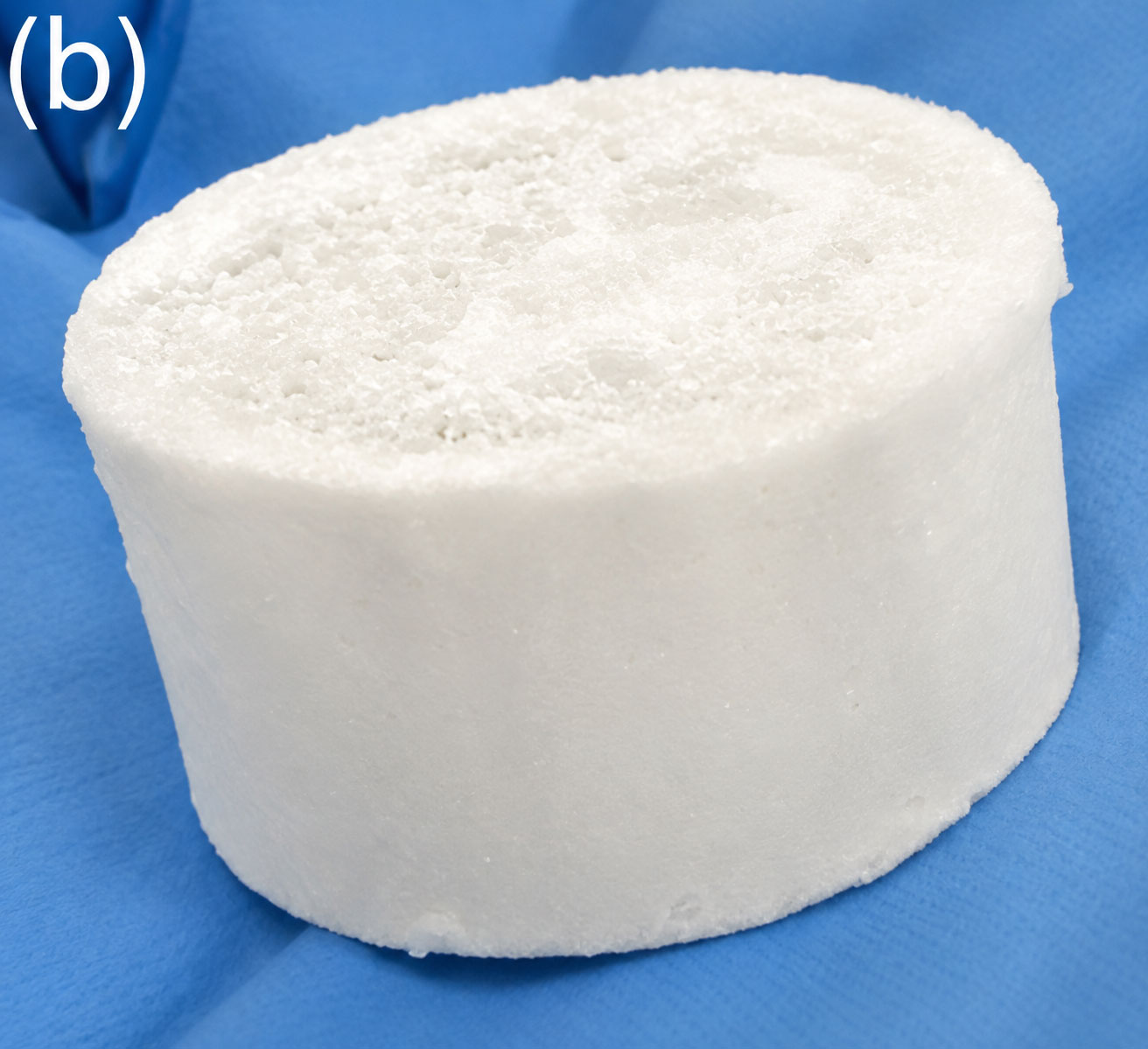 Testing the strength of “super ice”: A sample measuring 2 centimeters across and 1 centimeter high is placed in the compression-testing machine, which applies increasing pressure until the material begins to deform or break. Credit: Chen Adar
A new form of reinforced ice could offer an unconventional building material for extreme polar environments, although questions about its long-term durability remain.
Scientists have developed a new form of ice that approaches the compressive strength of conventional concrete while resisting the sudden fractures that make ordinary ice so brittle. Known as BioPykrete, the material is about 10 times stronger under compression than pure ice and can absorb roughly 70 times more energy before breaking.
Instead of shattering when cracks spread through it, the reinforced ice can deform and fracture more gradually. The research, led by Prof. Ido Braslavsky of the Hebrew University of Jerusalem’s Robert H. Smith Faculty of Agriculture, Food and Environment, was published in Colloids and Surfaces B: Biointerfaces.
Building Strength Into Ice at the Molecular Level
The material gets its unusual properties from cellulose nanocrystals, tiny, rigid particles derived from the natural substance that helps give plants their structure. As the material freezes, these particles form a three-dimensional network surrounding microscopic regions of ice.
To strengthen the connection between the two materials, the researchers designed a protein with separate regions that attach to ice and cellulose. This molecular bridge anchors the reinforcing network to the ice, creating a more tightly connected structure. Adding the protein doubled both the strength and energy absorption compared with a similar mixture containing cellulose but no engineered protein.
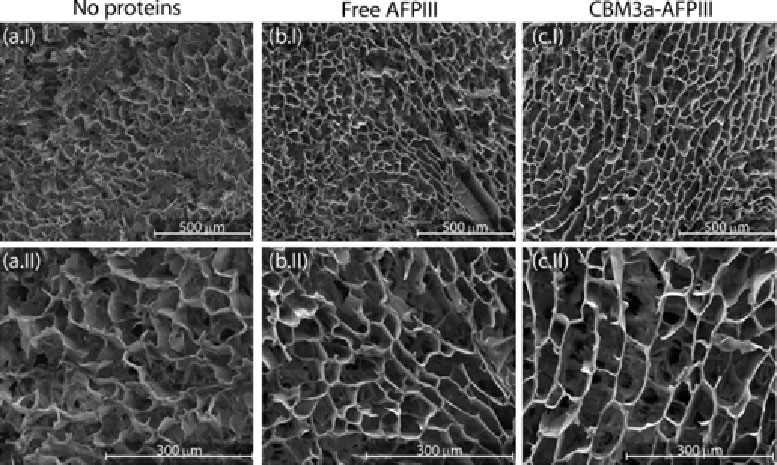 Inside the “super ice”: (a–c) Scanning Electron Microscope images of freeze-dried samples reveal the network formed by tiny cellulose crystals. The top row shows the material magnified 40 times, and the bottom row 90 times. (d) The graph compares the size of the network’s pores when the antifreeze protein AFPIII was added alone and when it was joined to the cellulose-binding protein CBM3a. Eight sample sections were analyzed for each material. Credit: Yulia Baron and Dr. Liat Bahari
“We wanted to go beyond simply mixing fibers into ice and instead control how the different materials connect at the molecular level,” Braslavsky said. “The result changes not only how strong the ice is, but also how it breaks. Instead of suddenly shattering, it can absorb much more energy and deform gradually.”
Why the Reinforced Ice Resists Cracking
Ordinary ice can fail suddenly because small cracks propagate rapidly through its crystalline structure. In BioPykrete, the cellulose network creates obstacles that can interrupt or redirect advancing cracks. The researchers propose that the protein connections make this network harder to deform or tear, increasing the energy required for fractures to spread.
The concept builds on an unusual experiment from World War II. Scientists developed Pykrete, a mixture of ice and wood pulp that was stronger and slower to melt than untreated ice. BioPykrete takes the same general approach but replaces conventional wood fibers with nanoscale reinforcement and molecular connections designed to improve mechanical performance.
Could Reinforced Ice Become a Building Material?
Researchers see potential applications in Arctic and Antarctic environments, where transporting conventional construction materials such as concrete and steel can be costly and logistically difficult. Because BioPykrete consists largely of ice and plant-derived cellulose, it could eventually provide a biodegradable alternative with a smaller carbon footprint for certain structures in extremely cold regions.
However, the material remains an experimental proof of concept. Its impressive laboratory performance does not establish whether it can withstand years of structural use. Researchers still need to investigate its response to repeated freezing and thawing, prolonged loading, and gradual deformation under sustained pressure.
Future experiments will examine how fractures develop within the reinforced structure and whether different proteins or freezing techniques can further improve its properties. These tests will help determine whether BioPykrete can move beyond laboratory samples toward practical construction applications.
Reference: “Biomimetic engineering of a fortified ice composite with enhanced mechanical properties” by Chen Adar, Yulia Baron, Baruch Rofman, Maya Bar Dolev, Liat Bahari, Victor Yashunsky, Vera Sirotinskaya, Oded Shoseyov and Ido Braslavsky, 2 August 2026, Colloids and Surfaces B: Biointerfaces.
DOI: 10.1016/j.colsurfb.2026.116037
Never miss a breakthrough: Join the SciTechDaily newsletter.
Follow us on Google and Google News.

















 English (US) ·
 French (CA) ·
 French (FR) ·