

PROTECT YOURSELF with Orgo-Life® QUANTUM TECHNOLOGY
Orgo-Life the new way to the future Advertising by Adpathway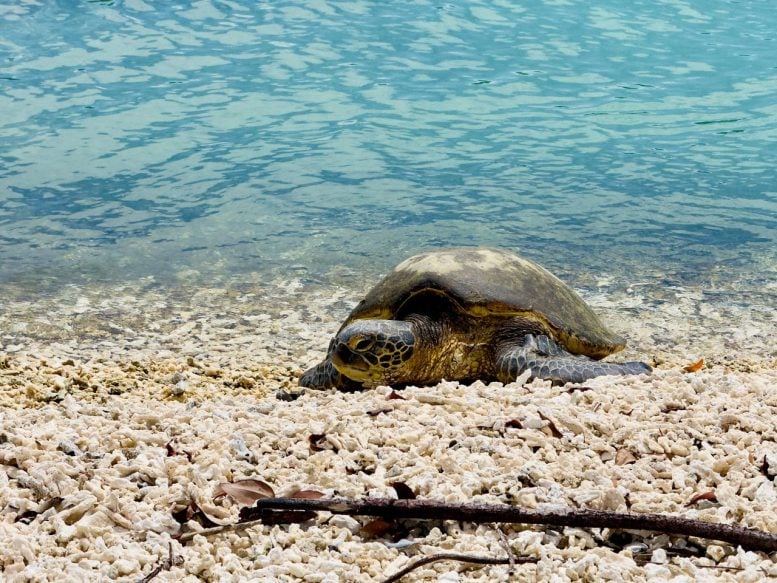 A green sea turtle rests along the shoreline beside the clear waters of the Galápagos Islands. Credit: Juan Pablo Muñoz-Pérez
Sea turtles are built for epic ocean journeys, yet some in the Galápagos rarely venture beyond their island neighborhood.
Sea turtles are renowned for long migrations between feeding grounds and nesting beaches. They navigate using signals that include Earth’s magnetic field, ocean currents, and the sun, often returning to the region where they hatched when it is time to breed. Researchers were therefore surprised when satellite tracking revealed yellow-morph green sea turtles that remained entirely within the Galápagos Marine Reserve.
“Here we show that ‘yellow-morph’ green sea turtles—one of two genetically distinct forms–occupy individual foraging areas which span one or more islands in the Galápagos. We expected them to migrate to distant beaches in the western Pacific to reproduce, yet interestingly, none of our satellite-tagged turtles even left the Galápagos Marine Reserve over the three years of our study,” said Dr. John W. Rowe, a professor at Alma College in the United States and corresponding author of a new study in Frontiers in Amphibian and Reptile Science.
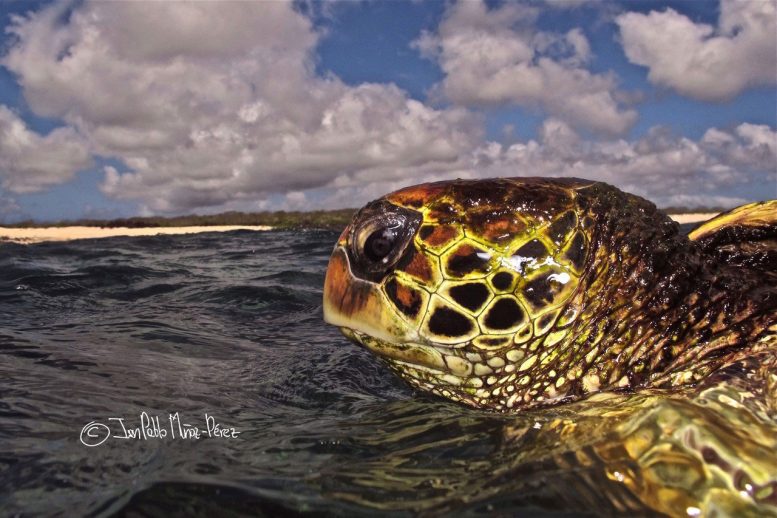 Yellow-morph green turtle, Chelonia mydas, in the Galápagos Islands. Credit: Juan Pablo Muñoz-Pérez
Two forms meet in the Galápagos
Green sea turtles are the only primarily vegetarian species among the seven living sea turtles. Hatchlings eat both plants and animals, but adults rely largely on algae and seagrasses.
The species includes two genetically distinct forms with largely separate ranges. Yellow morph turtles inhabit tropical and subtropical waters of the western Pacific. Black morph turtles occupy the eastern Pacific, west of the Americas and south of Southern California.
The Galápagos is the only known location where the two forms coexist. They gather in the same waters and feed on the same marine plants, yet young yellow morphs grow faster than young black morphs. That pattern points to physiological differences that scientists have not fully explained.
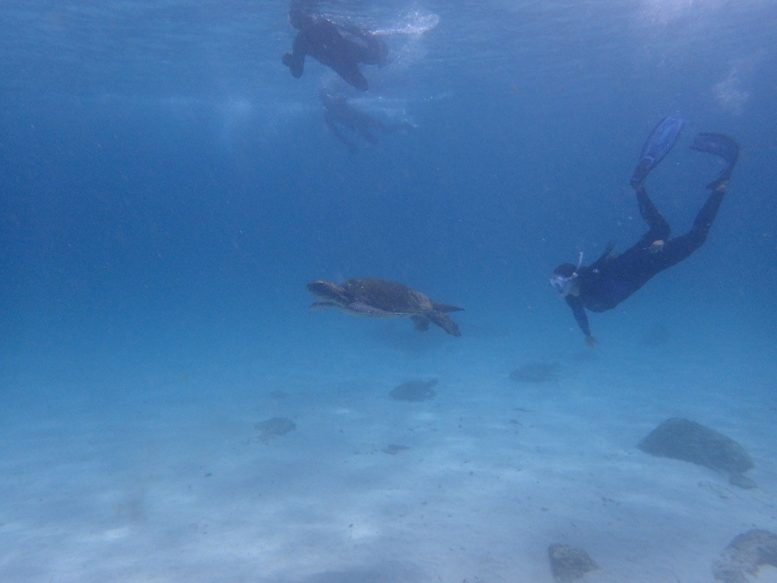 A snorkeler observes a green sea turtle swimming over the seafloor in the Galápagos. Credit: Juan Pablo Muñoz-Pérez
Satellite tags reveal limited journeys
To investigate where yellow-morph turtles travel, Rowe and his colleagues studied their habitat preferences, home ranges, and movements within the 198,000-square-kilometer (about 76,450-square-mile) Galápagos Marine Reserve. In 2015, they gently captured seven adult males and two adult females in shallow water near four islands.
The researchers gave each turtle a nickname and attached an electronic tag that transmitted location signals to the Argos satellite network in low Earth orbit. Tracking continued for as long as 418 days, usually ending when a tag detached or stopped transmitting.
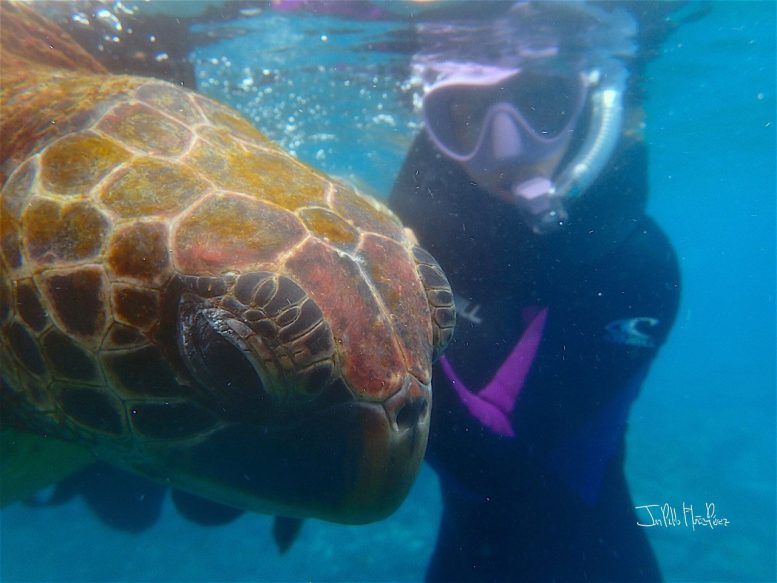 A snorkeler encounters a green sea turtle at close range in the waters surrounding the Galápagos Islands. Credit: Juan Pablo Muñoz-Pérez
Most turtles remained in shallow coastal water, although some occasionally traveled as far as 25 kilometers (15.5 miles) offshore. Five of the nine animals stayed mainly around one island. Bernardo and Sara moved between Isabela and San Cristóbal, while Leandro traveled between Isabela and Española.
Ainoa ranged the farthest. After being tagged near San Cristóbal, she moved first to Santa Cruz and then to Isabela. Every recorded journey between islands occurred during the cooler months from April through October. The average home range covered 1,498 square kilometers (about 578 square miles), but the amount of territory used differed widely among turtles.
A migration may still lie ahead
The findings suggest that yellow-morph green sea turtles can spend extended periods within a relatively restricted part of the Galápagos. Still, the study captured only a portion of their lives, so rare or seasonal migrations across the Pacific may have gone undetected.
Female yellow-morph turtles are not known to nest in the Galápagos, suggesting they eventually leave the archipelago and travel to distant beaches to lay their eggs.
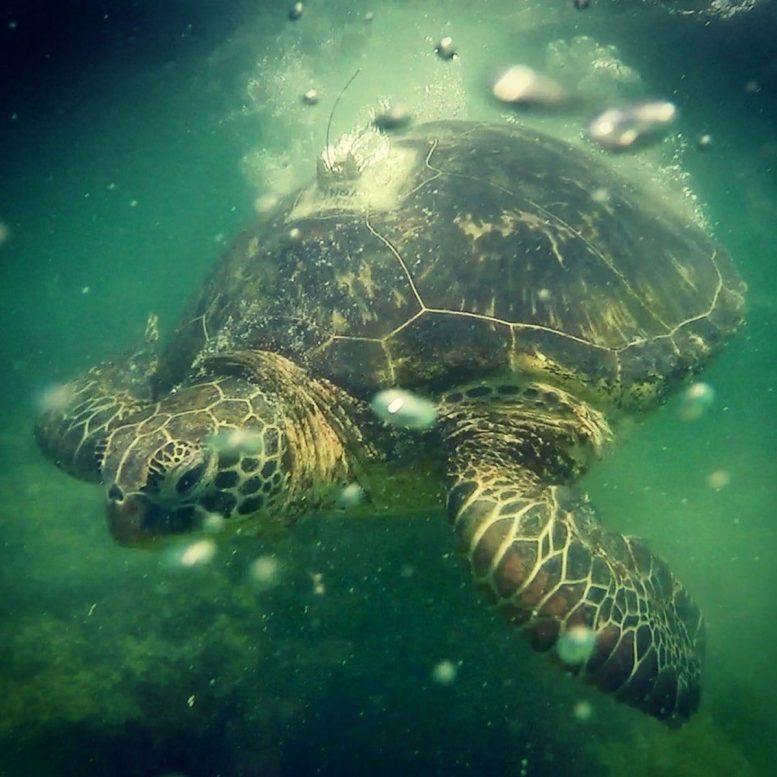 A green sea turtle swims through shallow coastal waters in the Galápagos Islands. Credit: Juan Pablo Muñoz-Pérez
“Since female yellow-morph green sea turtles are not known to lay eggs on the beaches of the Galápagos, we believe that they will eventually leave the area to return to their natal beaches in the western Pacific. In contrast, some female black-morph green turtles do nest in the Galápagos: depending on the individual, those may be year-round residents in the archipelago, travel to other nearby oceanic islands, or even to feeding grounds off Central and South America,” said coauthor Dr. Juan Pablo Muñoz Pérez, a professor at Universidad San Francisco de Quito in Ecuador.
Protection must extend across islands
The turtles’ movements also show why conservation cannot focus on a single feeding site. An animal that appears closely tied to one island may later depend on coastal habitat near another, as well as the open water corridors connecting them.
“Since individual turtles may rely on waters around multiple islands, the quality of habitat that is available for foraging should be maintained intact across all islands and not allowed to degrade anywhere,” said Rowe.
Reference: “Movements of yellow-morphotype green turtles (Chelonia mydas) in the Galápagos Marine Reserve” by Juan Pablo Muñoz-Pérez, Daniela Estefania Alarcón-Ruales, Lyndsey K. Tanabe, Catherine E. Hart, Maike Heidemeyer, Todd Steiner, Randall Arauz, Carlos A. Valle and John W. Rowe, 29 June 2026, Frontiers in Amphibian and Reptile Science.
DOI: 10.3389/famrs.2026.1837921
This study was funded by the DOW Foundation, Colegio de Ciencias Biológicas y Ambientales, Universidad San Francisco de Quito, Turtle Island Restoration Network, and Galápagos Science Center.
Never miss a breakthrough: Join the SciTechDaily newsletter.
Follow us on Google and Google News.

















 English (US) ·
  French (CA) ·
  French (FR) ·