

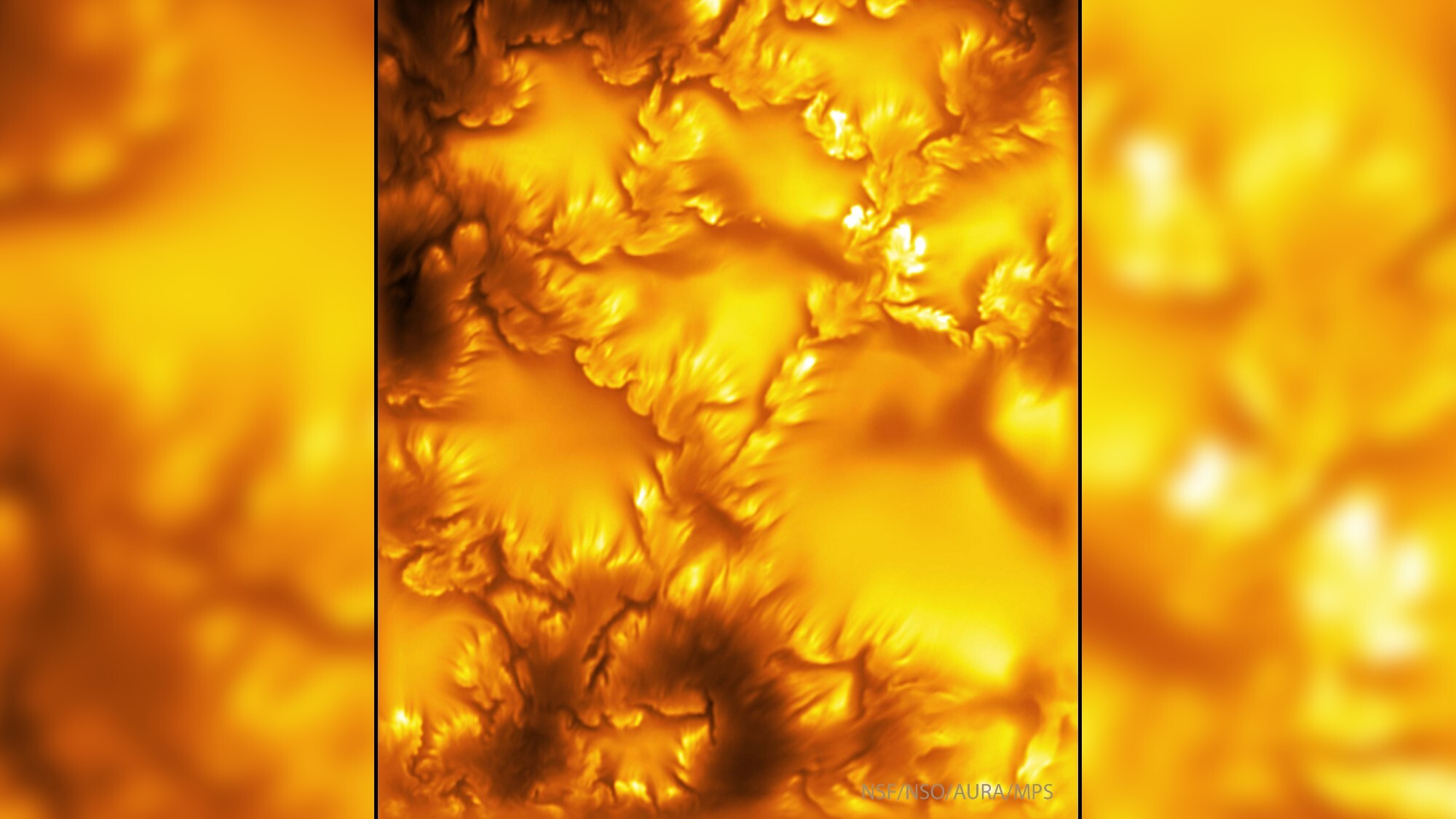
Scientists have captured the sharpest image ever of our sun's surface. This view has revealed incredible new details about the inner mechanisms driving stellar activity.
What is it?
An international team of researchers using the U.S. National Science Foundation's Inouye Solar Telescope has captured the highest-resolution view of the sun's surface.
In analyzing observations from this telescope, the team, made up of researchers from the National Solar Observatory, the NSF NCR High Altitude Observatory and the German Max Planck Institut für Sonnensystemforschung, discovered strange patterns on the sun's surface. The whirling patterns, they found, are actually evidence of what's called Kelvin-Helmholtz instability (KHI), or instability that happens when there is a change in velocity of fluids.
Why is it incredible?
This image is groundbreaking. Capturing the highest-resolution view of the sun's surface is a massive accomplishment, and in the time-lapse video above, you can even see the fluid dynamics on the surface of the sun in motion.
But this view is much more than a beautiful, high-resolution image. These observations have revealed swirls on the sun's surface at the edges of the magnetic areas, allowing the team to identify KHI on the sun's surface. This fluid instability has long been suspected on the sun, but these observations are the first time they have ever been directly seen like this.
“We believe that the discovery of Kelvin-Helmholtz Instability in the solar photosphere, backed up by analysis of numerical simulations, is a major step forward in our understanding of the dynamics and evolution of solar and stellar plasma, and will serve as a basis for future discoveries," David Boboltz, the deputy director at the National Solar Observatory, said in a statement.
A paper describing these findings was published recently in the journal Nature.























 English (US) ·
  French (CA) ·
  French (FR) ·