

PROTECT YOURSELF with Orgo-Life® QUANTUM TECHNOLOGY
Orgo-Life the new way to the future Advertising by AdpathwayIf at all possible, it is best to do whatever Thora Siemsen says.
Article continues after advertisement
So when she said “Can I send you a copy of this?” about Tom Cole’s forthcoming monologue Chimes published by The Song Cave, without any context, I got excited. It’s exactly the kind of book you want to send to someone without context, like a really good psychic or money. It’s a slim volume, which means it feels like a present instead of a burden. I related so much to the inner world of this gay ranter at the center of Chimes.
I understood that it took place in the early days of COVID, but it also felt so timeless, like we’re just kind of constantly living through these periods of profound isolation and crisis and normalcy and absurdity. I wasn’t familiar with Tom’s work previously only because he’s not on The Real Housewives of Beverly Hills which is where I source most of my cultural references. But after reading Chimes and then talking with him in my apartment during an intense thunderstorm, I am a Tom Cole nationalist. I hope you will send this book to some other lonely degenerate who is just trying to avoid the rain, with no context.
–Morgan Bassichis
*
Morgan Bassichis: Chimes was the very first thing I read after closing my show Can I Be Frank?, about another neurotic queer monologist, the late Frank Maya, and your monologue just felt like such a buoy and a balm in that weird and disorienting time after finishing something. I just gobbled it up and feel really grateful to have gotten to read it, and to now get to talk to you about it. On a really practical level, what was the process of writing this?
Tom Cole: Well, I presented sections of Chimes as an episodic audio play at Le Petit Versailles, a community garden in the East Village in the summer of 2020. We installed speakers at the edge of this beautiful garden and invited people to enter and listen to the drama as it unfolded in 45-minute episodes, a new one each week, over four weeks. I wrote it as fiction, and hope it reads that way, but with a theatrical flair—a hybrid. My feeling was that a monologue could seem immediate, more enjoyable and readable than a straightforward play with multiple characters, additional stage directions, etc.
I’m not a reliable narrator of my own experience, and I’m trying to capture that.
The first draft of Chimes was more than twice as long as the completed monologue. I entered into an extreme editing process to bring the work down to its current 120 pages. I took over 1000 notes from my editors at The Song Cave. I killed a lot of darlings partly because wanted the book to be short enough that it could be read in a day or two, and for that, I hope it feels like a show as much as it does a book.
TC: One of the things that I love about your work is your use of humor while dealing with very complex, difficult issues. That was my goal with this. I don’t know if you can tell I’m going for a laugh at every turn.
MB: Oh, big time. A crying queen is a scheming queen. I mean, one of the best lines I’ve ever read.
TC: At some point during one of your shows you have a line about a person dying if they don’t get a laugh.
MG: Oh, thank you for remembering that joke: I have a medical condition in which if you don’t laugh, I’ll die. Maybe not immediately, but definitely at some point.
TC: I have the same condition!
I’m grappling with the idea of the label “autofiction.” Would you refer to your work that way, as it seems to be so much about you? You’re also clearly performing a show, and that isn’t all true. What do you consider it?
MB: I don’t really think about it. Or, you know, for it to be funny it has to be true on some level. But that doesn’t mean it has to have happened. Do you know what I mean?
TC: Yes.
MB: Steve Martin has a great quote: “What’s funny is what’s happening, and there’s always something happening, so there’s always something funny.” And so it could be true on some level, but it’s not real. Or, it’s real… but it’s not true. I don’t feel any responsibility to stay inside of the facts. And also, I don’t always know what actually happened. Like, my perspective is not particularly dependable. I’m not a reliable narrator of my own experience, and I’m trying to capture that. On some level, I think your unnamed narrator, of course, is deeply unreliable. But also very reliable, in terms of their emotional truth. In my show I say my name is Morgan. Do you think of this character as Tom?
I’m definitely a shame-based writer.
TC: No. I purposefully left his name out, for a couple of reasons. I wanted to make sure that people understood that this was autofiction and not memoir, because so much of this didn’t happen, or happened in a very different way. It would be unethical to pretend that this is my story. It is very much constructed in order to get to the truth. But I can say that the emotional truth of the book relates to my core. What was it like for you to read this with a nameless narrator?
MB: I read it as if I was saying it. I was putting myself in the place of the narrator, and I suppose his not having a name made that more possible. It was kind of like this is just a psyche that I get to inhabit. And I enjoyed that experience the book gave me. So I wasn’t thinking, what’s their name? What’s the back story?
TC: The real-life aspect of the things that inspired me to write this book were so much grimmer than the book itself and not actually very funny. It’s all so much worse in real life!
MB: I find that the more you tell the ugly truth, the more people are like, yeah, that’s me too. It’s universal, especially the parts that we think are kind of bad, or absolutely shameful.
TC: I’m definitely a shame-based writer.
MB: Oh, me too.
TC: I grew up in Louisiana and North Carolina, and identify as a Southern writer, even though I have lived in New York for a long time. I love Southern Gothic writing. There’s a certain kind of gentility and politeness, and then on the flip side, dark humor and grotesquerie. I think you can tell from reading the book I was raised Catholic, and I feel like there’s a Catholic shame-based judgmentalism that, for better or worse, drives a lot of who I am and how I write.
MB: What do you personally get out of writing towards the shame?
TC: Hmm…it’s where I feel heat. And when I feel the kind of heat that tends to accompany my shame or embarrassment, I know I am onto something that should be included, even if it makes me uncomfortable. These are the sections I find audiences connect to in a more profound way. It’s a really masochistic way to work!
A few years ago, some of this book was excerpted in the anthology Eileen Myles edited, Pathetic Literature. On tour with Eileen to promote that book, I was really nervous about how this material was going to be perceived. People might think it was awful. Am I actually going to stand up and read this in front of all these people? And people laughed! They are related. I feel you might relate to that too with your work?
MB: I mean, I think of performing as being incredibly masochistic. Literally, my work is to try to make strangers laugh and to stare at their faces. I’m basically opening up my entire innards for them. And I see that also in the narrator of Chimes, the masochism of the narrator, the velocity of his needs. It’s almost like a compulsion.Performing is often hell. I mean, when it’s good it’s good, but often I experience it as a kind of masochism. Humiliation.
TC: Right.
MB: Can I read you a line from Chimes that I thought was a really good joke?
ToeTag loved me. His screen name referred to the tags you find tied to the toes of corpses. I love ToeTag back. We never spoke because when he came over, I was dead.
Perfect. A perfect… relationship, really! A perfect relationship, a perfect poem, a perfect joke.
TC: I really like that ToeTag goes as far as to pay for his pedicures. Don’t you find that above and beyond?
MB: I mean, that’s sexual hospitality right there. I find something so liberating in the depravity of this book. Sometimes when you’re gay and you look around at your life, you’re like, this is so depraved. Like, this is crazy, what is happening right now?! I felt what I believe is called “seen” in this book.
TC: I’m really thrilled to hear that. I wanted it to be a different reading experience, to be fast, like you’re in… and you’re out, almost like going to a show, but of course you’re reading it. And I wanted it to be really fun and enjoyable, even though it’s about what it’s about, you know?
MB: Mission accomplished. After finishing it I immediately asked The Song Cave if they could send an advance copy to my friend Neil Greenberg, because I just knew he was going to love it, too.
TC: I think Neil’s a genius. And he worked with you on Can I be Frank?
MB: He is the reason the show happened, not only because he took meticulous care of Frank’s archive and welcomed me into Frank’s world, but also because Neil is a true artist himself. He understands that artists have to also make their own work, that even archivally-driven work needs to go its own way. He kept saying, “Make your own piece of work.”
It really feels like you’re untangling American sexuality by going directly into the tangle.
Now, you’ve done a lot of labor to cultivate and welcome other people’s work, through your day job commissioning and producing theater, and the work you do at Dixon Place and with other artists. You are kind of midwifing, doulaing other people’s art. And that is, trigger warning, sorry to use the word sacred, but it really is sacred work. What’s your dream for Chimes, for your own work? If you could snap your fingers, would it be you performing this or somebody else?
TC: I have a complicated answer to that question. I’d rather it be someone else, but I think, also, that maybe there’s something about doing it myself that might make it more touching or pathetic. I don’t know. What do you think?
MB: I think you owe it to yourself to try, even just as an experiment. If you immediately skipped over it and said it had to be somebody else performing it, there would always be that question of “Should I have done that?”
TC: But if someone came to me and said, hey, I’m interested in doing something with this monologue myself, I wouldn’t hesitate.
MB: Can I keep reading parts to you? This is not me auditioning! Or maybe it is! There’s this scene in a hotel, where the narrator is a teenager, and is sleeping in the same hotel room with his parents, with the father basically forcing the mother to have sex.
TC: That’s right.
MB: My father woke up, got on top of my mother, humped her, dazed. Only half awake, she said, not now, but he kept humping and humping and she rolled away, him, mad. I was titillated, repulsed. While he pseudo-forced my mother to have sex I closed my eyes and fantasized about being downstairs in the grimy bathroom, on my knees, blindfolded, waiting, a fat boy waiting to take all comers. And then it shifted—some part of me wanted to be my mother. She didn’t get him off. He got out of bed and I heard him jerk off into the toilet. I was thinking, I’d have gotten him off.
It really feels like you’re untangling American sexuality by going directly into the tangle. I just love it.
TC: Thank you. I like that you were laughing when you just read that.
MB: That part? Yeah. All of it. Oh, also this quote: I had a lot of sexual energy as a child. I mean, that could be like the title of ….
TC: Our interview.
MB: Our shared memoir! I had a lot of sexual energy as a child, for sure.
TC: Should we put that up at the top? Let’s put that up at the top. Let’s try it.
__________________________________
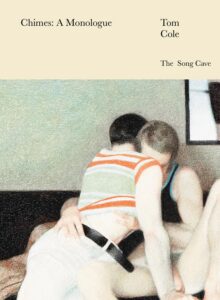
Chimes by Tom Cole is available from the Song Cave.

















 English (US) ·
  French (CA) ·
  French (FR) ·