

 2 months ago
75
2 months ago
75
PROTECT YOURSELF with Orgo-Life® QUANTUM TECHNOLOGY
Orgo-Life the new way to the future Advertising by AdpathwayBRUSSELS — After a bruising year of infighting, crises and recriminations, NATO countries are opting for a by-now-familiar playbook at the Ankara summit: Placate Donald Trump, and pray for no surprises.
NATO leaders gather in Turkey on Tuesday hoping for a show of unity after a year of unprecedented strain on the alliance, largely thanks to the U.S. president. After threatening to annex Greenland, Trump repeatedly bludgeoned allies for not helping Washington’s war effort in Iran — while his administration vowed reprisals for those not spending enough on defense.
European NATO allies are pulling out the stops to prevent a Trump blow-up. That means promoting the big bucks being spent on defense, keeping the focus on the less divisive topic of industry, pledging further efforts to rearm and signaling their support on Iran.
“There’s no alternative how to approach him but to be diplomatic and not to extremely offend him and saying that we’re stepping up,” Belgian Defense Minister Theo Francken told POLITICO. “That’s what we need to do and that’s what we’re doing.”
The aim is to “keep one person happy and satisfied,” added one senior NATO diplomat, who like others for this story was granted anonymity to speak freely on the sensitive matter. “It’s all about Trump management.”
Yet despite NATO’s best efforts to keep the agenda consensual, Trump remains unpredictable. Anger over defense spending, U.S. access to European bases and defense cash — and the volatile ceasefire in Iran — could all set him off.
“If this conflict flares up again — which can’t be ruled out — and then Trump again puts [out] statements that Europeans should step up,” said Gerlinde Niehus, a security expert and longtime NATO official, “then that topic would of course overshadow everything else.”
Going into the summit, a senior White House official described Trump’s mood as “a combination of optimism but also a level of being perturbed” over Iran.
No expense spared
NATO allies have gone to great lengths to keep Trump onside.
First, that means framing the summit in terms the U.S. president cares about, said a second senior NATO diplomat: “Money.”
NATO chief Mark Rutte has sought to make the case that allies are unleashing a tidal wave of cash since they committed last year to spending 3.5 percent of their GDP on defense by 2035. On a visit to Washington last month, he unveiled a chart with the headline “The Trump trillion.” Since 2025, Rutte told him, allies have spent an extra $139 billion on defense.
At an industry side event in Ankara, allies will also pledge “double digit” billions in procurement deals, said a person familiar with the matter.
 NATO Secretary-General Mark Rutte is pictured in The Hague on June 23, 2025. | Omar Havana/Getty Images
“This will be the biggest defense industry forum ever — in terms of projects … to be announced,” Turkey’s envoy to NATO Basat Öztürk said.
Next, Rutte has sought to center the summit around scaling up defense production.
In part, that reflects a genuine challenge Europe faces in transforming its newfound spending into real battlefield kit. But it’s also a deliberate effort to keep the discussion on an agreeable topic, said two other NATO diplomats — and entice Trump with promises of further arms deals and joint ventures that benefit U.S. industry.
Allies are seeking reconciliation on Iran, too. Despite it being far outside NATO’s core task of defending Europe, allies have agreed to allude to the U.S. war in Iran as part of the summit declaration, according to details of the draft shared with POLITICO — demanding the Strait of Hormuz remain open and that Tehran never acquires nuclear weapons.
That’s a clear olive branch to Trump, two NATO diplomats said, given the alliance divisions over the U.S.-Israeli war in Iran.
Finally, allies will pledge to continue taking over the burden of responsibility for Europe’s defense. After the U.S. downsized capabilities like jets, bombers and destroyers from NATO’s war plans in May, other countries stepped up by offering more of their own forces — with most of those capabilities now replaced.
Ankara anxieties
But even careful preparation can’t immunize NATO from a Trump explosion — and so far, the signals don’t look positive.
Last week, Trump again slammed allies for their defense spending. “Ridiculous for the U.S.A. to continue along this one sided path when the relationship is not reciprocal,” he wrote.
The remarks came after U.S. Defense Secretary Pete Hegseth delivered a blistering rebuke of some NATO allies, announcing a six-month review of U.S. troop deployments in countries underperforming on defense spending. Reportedly, he had also considered immediately cutting forces.
That might mean targeted criticism, too. Slovenia, Albania and the Czech Republic last year failed to meet NATO’s earlier 2 percent of GDP spending target — while others, like the U.K., have come under fire for their future plans. Lithuanian President Gitanas Nausėda said Friday that NATO risks a “split” if some countries fail to meet their spending target.
Closely related to that is the U.S. president’s lingering anger over European allies’ opposition to joining the Iran war. While a Franco-British initiative is under way to help reopen the Strait of Hormuz once a peace deal is agreed, the ceasefire remains fragile.
In Berlin, there are also fears that Trump could derail the summit by demanding Europe contribute to a purported €300 billion reconstruction fund for Iran, according to two German officials.
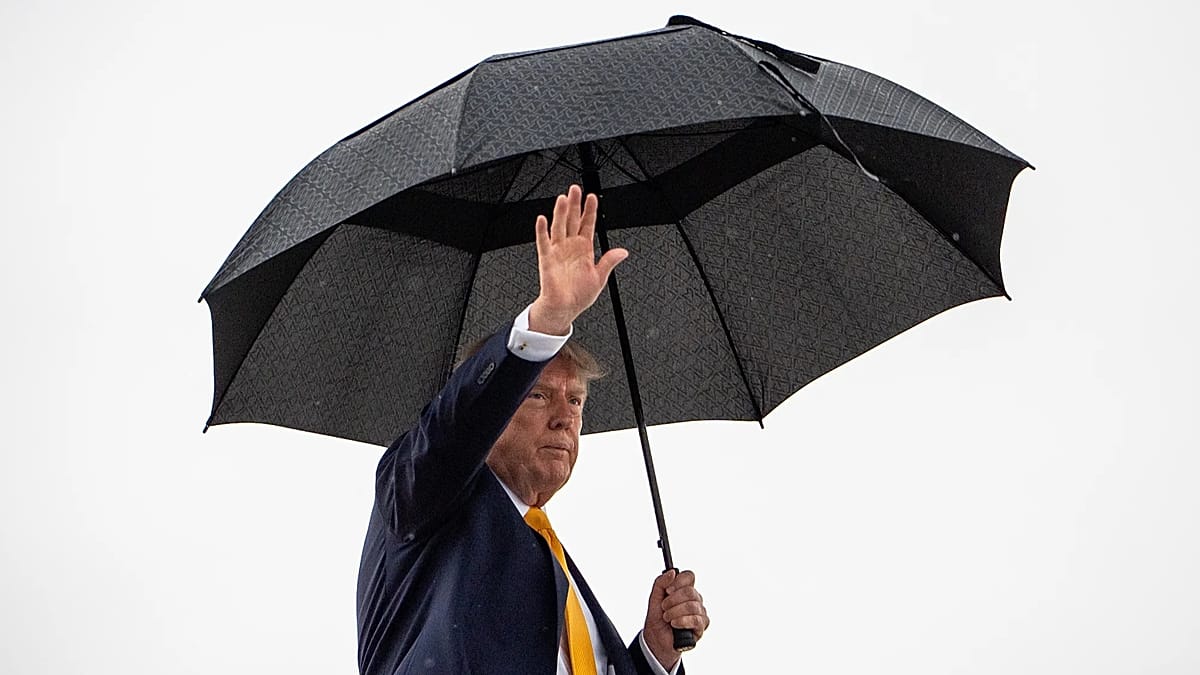
 U.S. President Donald Trump arrives for a press conference during a NATO summit in The Hague on June 25, 2025. | Brendan Smialowski/AFP via Getty Images
“It’s vital for these countries to live up to their security promises” and spending targets, said the senior White House official. They also expressed optimism that there might be some sort of European recommitment to bilateral military arrangements after several countries restricted U.S. use of military bases for the Iran campaign.
Trump might also butt heads with European allies, like France, which advocate for greater protectionism in defense spending, embodied by initiatives like the EU’s loans-for-weapons SAFE scheme. Referencing the promotion of Turkish industry at the summit, French Deputy Defense Minister Alice Rufo told POLITICO: “We need to be careful that European industry … is appropriately taken into consideration” at Ankara.
“We certainly do not support the protectionist language that, oftentimes, many of the European defense initiatives have included, that would cut out allies,” U.S. Ambassador to NATO Matthew Whitaker said last week.
Many of the procurement deals, meanwhile, are likely to be repackaged. Allies have less political or fiscal space to offer Trump major new pledges, the same two diplomats said. In reality, they are offering Trump “very little,” said Niehus. “There is no big deliverable.”
‘Major transformation’
Yet behind the scenes, allies feel the days of NATO’s unfettered appeasement of the U.S. president are numbered.
Europe and Canada still only account for 41 percent of NATO’s total defense spending — although that skews in Washington’s favor because the U.S. has vast defense spending unrelated to Europe. Washington also has unique capabilities like intelligence, reconnaissance and surveillance, and air-to-air refueling alongside its nuclear umbrella.
But as non-U.S. defense spending grows, so will allied self-confidence. “This is the biggest transformation of NATO in history … I’m not sure everyone understands that in the U.S. administration,” said the first senior NATO diplomat. “They’re so used to leading,” they said, but that may change “in the coming years.”
In fact, that’s already happening. A U.K.-led grouping of around a dozen countries is set to announce a new coalition to develop deep precision strike capabilities at Ankara, despite skepticism from U.S. officials who warn long-range missiles increase the risk of escalation with Russia.
Europeans may also start being more demanding with Washington in shifting military assets across the alliance and in drafting war plans in NATO’s next four-year planning cycle, the two diplomats said.
“We need the Americans, [we will] be diplomatic, listen to what they say, try to be gentle,” said Francken. But “we need to be more pragmatic and always think what is in our interests.”
Megan Messerly contributed reporting from Washington and Hans von der Burchard contributed reporting from Berlin.


 English (US) ·
  French (CA) ·
  French (FR) ·