

 2 months ago
62
2 months ago
62
PROTECT YOURSELF with Orgo-Life® QUANTUM TECHNOLOGY
Orgo-Life the new way to the future Advertising by Adpathway(UPSC Ethics Simplified is a special series under UPSC Essentials by The Indian Express that examines ethical concepts relevant to the Civil Services Examination. Today, our ethicist explains why responses to protests are an ethics case study and how aspirants can approach such situations ethically, drawing lessons in the light of the recent CJP protests.)
Every year, current affairs present us with situations that test not only the law but also our understanding of ethics. Public protests, demonstrations, and crowd management are among the most challenging responsibilities in governance. Today, you may analyse them as newspaper headlines. Tomorrow, they may appear as GS Paper IV case studies. One day, as administrators, police officers, or policymakers, they may become your own decisions to make.
This is precisely why Ethics is one of the most practical papers in the UPSC examination. It is not merely about defining values or memorising thinkers. It is about applying ethical principles to complex, real-life situations where there is no perfect answer, only a more balanced and reasoned one.
Why crowd management, especially protests, is an ethics case study
Whenever situations involving protests, demonstrations, or crowd management arise, several questions naturally emerge.
1. How should the State balance the rule of law with the constitutional right to peaceful expression?
2. When should communication take precedence over coercive measures?
3. Should force always remain the last resort, and what standards of accountability should govern its use?
4. What role should empathy, restraint, proportionality, emotional intelligence, and constitutional values play while maintaining public order?
Story continues below this ad
5. What ethical responsibilities do citizens have while exercising their democratic rights?
6. How can institutions and the public together ensure that disagreements do not escalate into confrontation?
These are not merely current affairs questions; they are classic Ethics paper questions. They involve competing values, multiple stakeholders, conflicting duties, and difficult choices. Ethics does not ask us to choose one side over another. Instead, it asks us to identify the stakeholders, appreciate competing values, evaluate alternative courses of action, and arrive at the most ethical and practical solution.
Law vs Compassion: The core ethical dilemma
One of the most common ethical dilemmas in public administration is balancing law with compassion. Maintaining public order is an essential responsibility of the State, but so is protecting human dignity. Likewise, while citizens have every right to express their views peacefully, they also have a responsibility to exercise that right within the constitutional framework. Good governance is rarely about choosing one over the other; it is about harmonising both.
Story continues below this ad
Many situations involving public protests demand not only legal judgement but also ethical judgement. Communication, negotiation, persuasion, patience, and empathy often become as important as enforcement. Wherever circumstances permit, dialogue should be exhausted before coercive measures are considered. The objective is not merely to restore order but also to preserve public trust. In many situations, trained Civil Defence personnel, mediators, or community representatives can complement law enforcement by helping de-escalate tensions. Such approaches demonstrate that empathy and firmness can coexist.
Beyond legality: what ethics demands
By definition, ethics refers to the principles of conduct governing individuals and groups. In public administration, ethics goes beyond legal compliance. It examines what is right, fair, proportionate, and just. It encourages us to ask whether our decisions reflect values such as restraint, empathy, accountability, integrity, self-discipline, moderation, and respect for human dignity.
Ethics is the systematic examination of morality. It encompasses both the process of inquiry and the conclusions drawn from that inquiry. Morality is the subject matter that ethics investigates. Ethics studies the standards established by individuals, institutions, and society regarding right and wrong, good and bad. Therefore, every decision involving governance requires not only legal authority but also ethical reasoning.
The ethical decision-making framework
Every important decision follows an ethical decision-making process, a framework that is equally valuable for solving UPSC case studies and for resolving real administrative challenges.
Step 1: Recognising the Ethical Issue
Story continues below this ad
The first step is recognising that a situation presents an ethical issue. Situations involving protests and crowd management often involve competing rights, competing responsibilities, and competing expectations. They therefore require moral sensitivity. Such sensitivity emerges from moral reasoning, through which actions are evaluated against accepted ethical standards. Both institutions and citizens are expected to uphold these standards.
Step 2: Moral Judgement and Moral Reasoning
Ethical judgement requires facts, context, sound reasoning, and emotional intelligence. It also demands an awareness of personal as well as institutional biases. Decisions taken in emotionally charged situations must be informed not only by legal provisions but also by an understanding of human behaviour.
Step 3: Understanding crowd behaviour before managing it
This is where theories of collective behaviour become relevant. For more than a century, social scientists have studied how individuals behave in crowds. Gustave Le Bon described crowd behaviour as a social phenomenon in which people may temporarily lose their sense of individuality and rational judgement. Later, sociologists Ralph H. Turner and Lewis M. Killian, through Norm Theory, argued that crowd behaviour develops through social interaction and shared norms that emerge within the gathering itself. These perspectives remind administrators that crowd management is not merely about controlling numbers; it is equally about understanding behaviour.
Step 4: Institutional Culture and Ethical Leadership
Ethical decisions are influenced by institutional culture. Every institution develops values that shape the conduct of its members. An institutional culture rooted in professionalism, restraint, accountability, transparency, care, empathy, and respect for constitutional values strengthens public confidence while effectively maintaining law and order. Likewise, responsible citizenship requires peaceful conduct, cooperation with lawful authority, and respect for democratic institutions. Sustainable public order is possible only when both institutions and citizens fulfil their respective responsibilities.
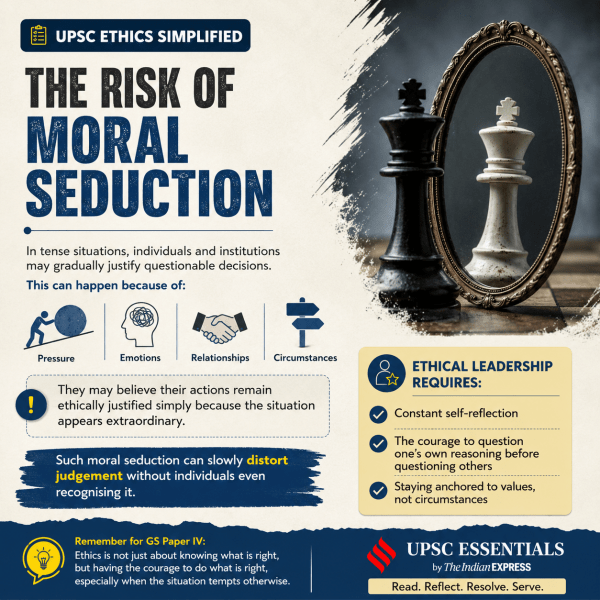
Story continues below this ad
Lessons for future civil servants
Protests and crowd management are not merely topics for Current Affairs. They are among the finest examples through which the Ethics paper teaches administrators to balance competing constitutional values. Every such situation can be analysed through the lenses of stakeholders, ethical dilemmas, values in public service, emotional intelligence, accountability, integrity, empathy, proportionality, and ethical decision-making. If you develop this habit today while preparing for GS Paper IV, you will be far better prepared for the responsibilities that public service will place upon you tomorrow.
Perhaps this is the most enduring lesson that Ethics offers. The real challenge is rarely about choosing between law and compassion. It is about ensuring that the rule of law is exercised with humanity wherever circumstances permit, and that democratic freedoms are exercised with equal responsibility. So, governance become not only effective but also ethical when:
1. institutions communicate before they compel (along with competence)
2. citizens cooperate before confrontation (along with participation)
3. every stakeholder acts with restraint (along with wisdom)
With best wishes,
Nanditesh Nilay
(The writer is the author of ‘Being Good’, ‘Aaiye, Insaan Banaen’, ‘Kyon’ and ‘Ethikos: Stories Searching Happiness’. He teaches courses on and offers training in ethics, values and behaviour. He has been the expert/consultant to UPSC, SAARC countries, Civil services Academy, National Centre for Good Governance, Central Bureau of Investigation (CBI), Competition Commission of India (CCI), National Judicial Academy, etc. He has PhD in two disciplines and has been a Doctoral Fellow in Gandhian Studies from ICSSR. His second PhD is from IIT Delhi on Ethical Decision Making among Indian Bureaucrats. He writes for the UPSC Ethics Simplified (concepts and caselets) fortnightly.)
Subscribe to our UPSC newsletter and stay updated with the news cues from the past week.
Story continues below this ad
Stay updated with the latest UPSC articles by joining our Telegram channel – Indian Express UPSC Hub, and follow us on UPSC section of The Indian Express on Instagram and X.
For your queries and suggestions write at manas.srivastava@indianexpress.com
PREVIOUS ARTICLES ON UPSC ETHICS SIMPLIFIED:
Railway linen theft : A Case Study in everyday ethics
How to decode ethical quotes in Mains exam: An example
Can ethics stop the next fire tragedy?
Story continues below this ad
How can India’s civil services and governance rebuild Gen Z’s trust?
CBSE row as a case study on accountability when technology fails
NEET Paper Leak: What is ethical governance in public examinations?
Dear UPSC aspirants, how do you know what’s ethical in everyday life
Are humans failing ethically in the AI age?
Story continues below this ad
How fake success claims by aspirants reveal a deeper moral crisis



















 English (US) ·
  French (CA) ·
  French (FR) ·