

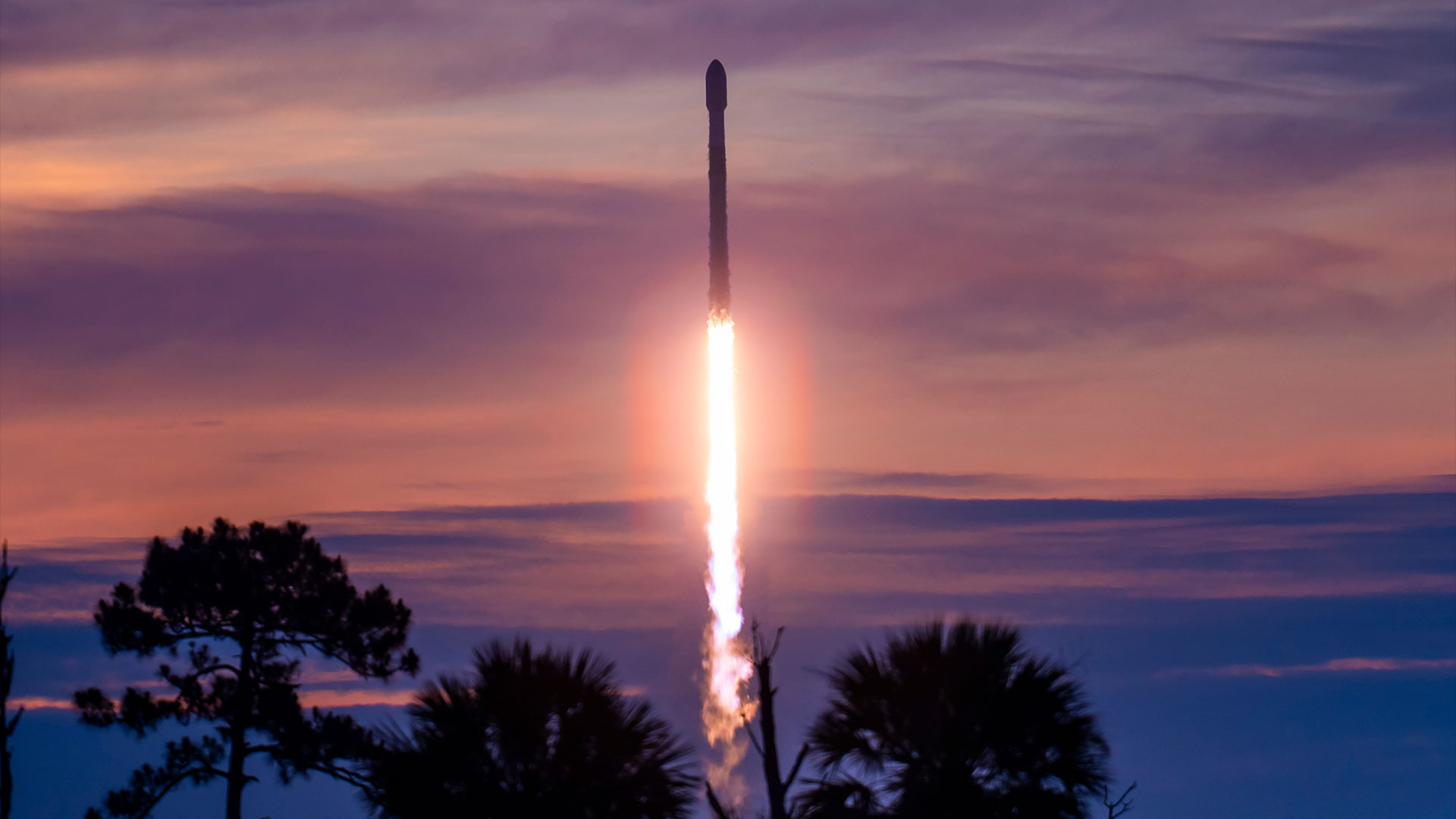
A SpaceX Falcon 9 rocket will launch for a record-breaking 36th time early Thursday morning (July 9), and you can watch the action live.
The Falcon 9 is scheduled to lift off from Florida's Cape Canaveral Space Force Station on Thursday at 5:25 a.m. EDT (0925 GMT), carrying 29 of the company's Starlink broadband satellites to low Earth orbit (LEO).
You can watch it live via SpaceX beginning about 10 minutes before launch.
This particular booster, known as 1067, has already completed 35 orbital missions, more than any other SpaceX rocket in history. The overall record is held by NASA's space shuttle Discovery, which flew to orbit and back 39 times.
Thursday's flight will extend Booster 1067's company record. If all goes to plan, the rocket will come back to Earth about 8.5 minutes after liftoff, landing on the SpaceX drone ship "A Shortfall of Gravitas" stationed in the Atlantic Ocean.
The Falcon 9's upper stage, meanwhile, will haul the 29 Starlink satellites to LEO, deploying them there 63.5 minutes after launch.
Previous Booster 1067 missions
Thursday's launch will be the 80th Falcon 9 mission of the year already. About 80% of the rocket's 2026 flights have been devoted to building out Starlink, by far the largest satellite network ever assembled.
The megaconstellation currently consists of more than 10,700 active satellites, according to tracker Jonathan McDowell. And, as the upcoming launch shows, that number is growing all the time.
























 English (US) ·
  French (CA) ·
  French (FR) ·