

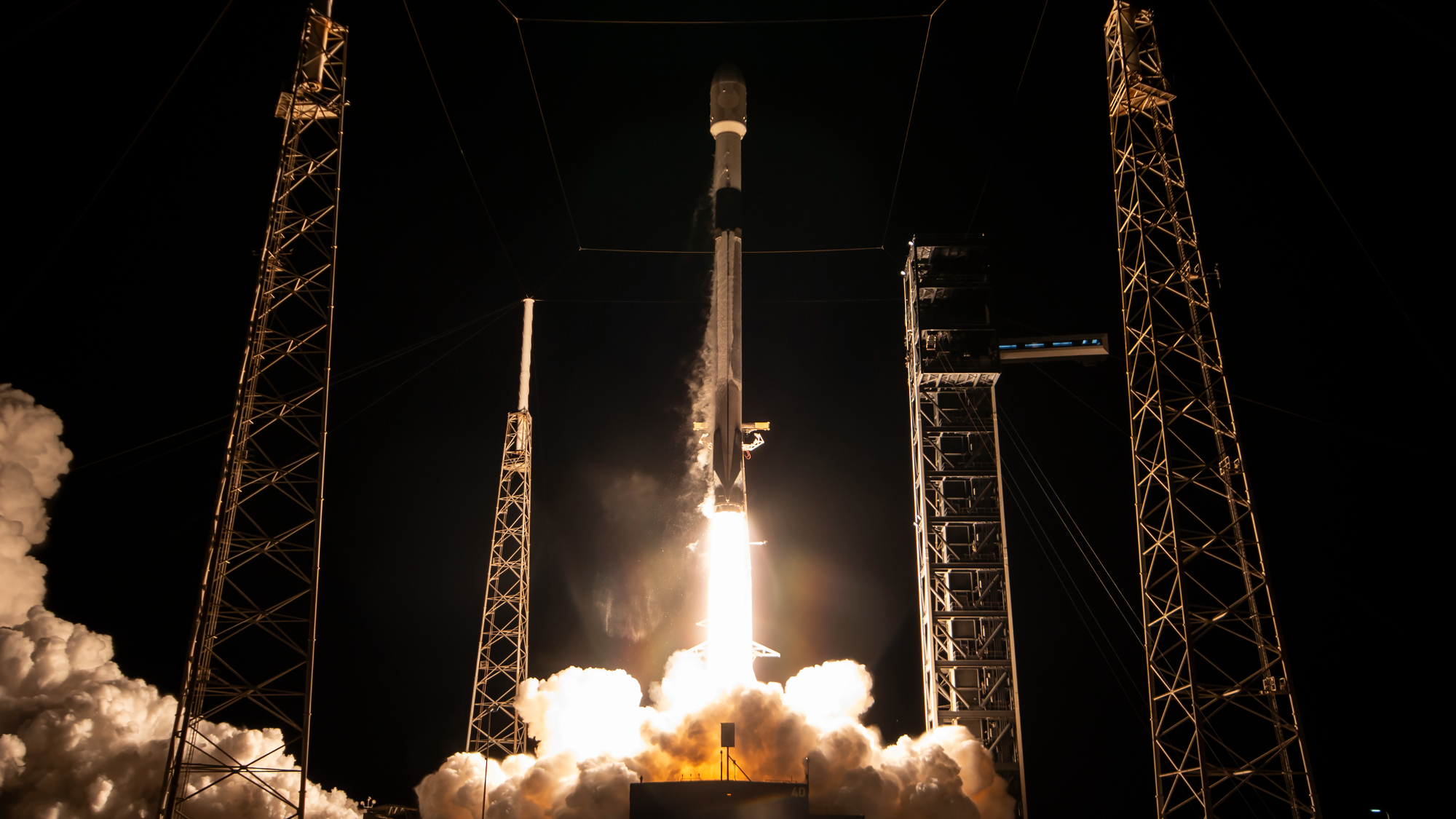
SpaceX will launch a new GPS satellite for the U.S. Space Force early Monday morning (April 20), and you can watch the action live.
A Falcon 9 rocket topped with the GPS III SV10 satellite is scheduled to lift off from Florida's Cape Canaveral Space Force Station on Monday, during a 15-minute window that opens at 2:57 a.m. EDT (0657 GMT).
GPS III SV10 (short for "Space Vehicle 10") is the 10th and final satellite in the United States' advanced GPS III line.
"GPS III satellites have a three-fold increase in positional accuracy and an eight-fold improvement in jam resistance compared to prior versions," Space Force officials said in a statement on Jan. 28, just after GPS III SV09 rode a Falcon 9 to orbit.
"These advanced features enable the constellation to provide an across-the-board boost in effectiveness and lethality to weapon systems in every theater," they added.
GPS III SV10 was originally supposed to fly aboard United Launch Alliance's new Vulcan Centaur rocket. Last month, however, the Space Force announced that it was switching the satellite to a Falcon 9 due to issues that Vulcan has experienced with its solid rocket boosters (SRBs).
As part of this rocket swap, Vulcan Centaur will now launch the USSF-70 national security mission, which had been slated to fly on a SpaceX Falcon Heavy. USSF-70 is expected to launch no earlier than summer 2028, Space Force officials have said. (Presumably, Vulcan Centaur's SRB issues will be worked out by then.)
If all goes to plan on Monday morning, the Falcon 9's first stage will come back to Earth about 8.5 minutes after launch, touching down softly in the Atlantic Ocean on the SpaceX droneship "Just Read the Instructions."
It will be the seventh launch and landing for this particular booster, according to a SpaceX mission description.
The Falcon 9's upper stage, meanwhile, will continue powering its way to medium-Earth orbit. It will deploy GPS III SV10 there about 90 minutes after liftoff.



















 English (US) ·
  French (CA) ·
  French (FR) ·