

 1 hour ago
11
1 hour ago
11
PROTECT YOURSELF with Orgo-Life® QUANTUM TECHNOLOGY
Orgo-Life the new way to the future Advertising by AdpathwayFrom her wooden veranda in Fiji’s remote Yasawa islands, climate activist Lavenia Naivalu remembers when the reefs were once so healthy, her grandfather would walk to the shoreline and return with fish. But life there has changed.
“The reefs that the older generation of men spearfished in, no longer provide what they once did,” the 44-year-old says. “Young people … now must travel further out to sea to find fish for their families.”
As she looks out at a white sandy beach, eaten away by rising sea levels, Naivalu recounts watching painfully as her three children “feel the brunt of changes in the climate.
“I ask myself ‘what did they do wrong?’”
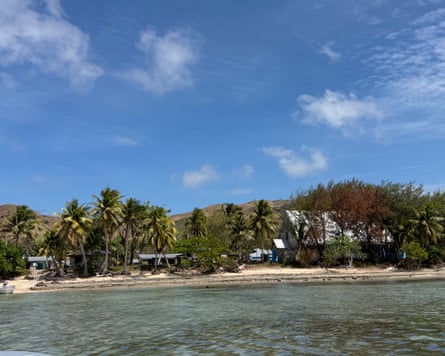
The question is personal, but it’s also part of what drives her pursuit of climate justice for Pacific people, whose way of life is being threatened as the planet warms.
At this year’s UN climate talks, known as Cop31, the region will be in the spotlight like never before. Next week, Fiji will host leaders ahead of the climate summit, where Naivalu hopes to draw attention to Indigenous and Pacific perspectives which she says are often relegated in global negotiations.
The Pacific Islands are disproportionately affected by the climate crisis, despite accounting for just 0.02% of global emissions, according to the United Nations.
“One thing that triggers me is when somebody else is speaking on my behalf,” she tells the Guardian. “I want to amplify the voices of my community and the people that I represent directly to all leaders.”
Naivalu, an Indigenous representative participating in the Fiji meeting and the Cop31 summit in Turkey, has been a trailblazing advocate for her people.
She was Fiji’s first female mata ni tikina, or district representative, overseeing seven village chiefs under the traditionally male-dominated governance system. Naivalu was also the first Indigenous representative selected to Fiji’s tourism board.
A veteran of past Cop summits, Naivalu – who lives on the island of Nacula in the Yasawa islands – says bringing the climate talks home matters, but she wants discussions to move beyond language that people do not see reflected in their daily lives.
“We talk about climate change, climate finance, about adaptation and mitigation,” she said. “But my people in Nacula don’t know what climate finance is; what we want to know is action.”
On the frontline of the crisis
Turkey and Australia agreed last year that the Pacific would host preparatory meetings before Cop31 under a compromise deal to resolve a standoff about where the 2026 summit would be held. The summit will be hosted in Turkey’s Mediterranean resort city of Antalya in November, while Australia will chair negotiations.
Sivendra Michael, Fiji’s permanent secretary for environment and climate change, said Naivalu “closes the distance between negotiating room and the reef.
“Fiji will go into Cop31 arguing for direct access to finance, for adaptation that is actually delivered at community level, and for Indigenous knowledge to be treated as evidence rather than decoration,” he said.
“We are asking the world to trust Pacific leadership. That argument is far stronger when Pacific leadership is not confined to officials like me.”
Having grown up in Nacula village, Naivalu has seen the impact of the climate crisis first-hand.
“Water sources that used to sustain our village are now drying up, while seawater increasingly threatens the hand-dug wells,” she said.
Nacula is doing its best to adapt to climate change – families now store drinking water for dry periods and women preserve food.
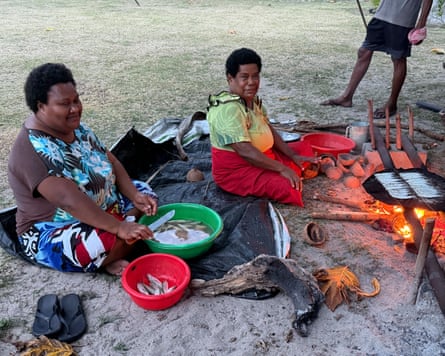
Village chief, Ratu Manasa Naikasowalo, said he sees the value of Naivalu’s advocacy.
“Her work has helped bring important connections and practical initiatives back to the community, including food security, salt making, coral planting and food-preservation programmes,” Ratu said.
Naivalu knows adaptation cannot be left solely to frontline communities, and has witnessed the gap between Cop discussions and what happens at home.
In Fiji next week, she will be bring the lived experiences of Indigenous communities into the Cop31 process, pushing for their voices to be heard as leaders negotiate climate finance, adaptation, loss and damage, and keeping global warming within 1.5C.
“I don’t attend Cop to worry about texts and brackets; I attend Cop to forge partnerships with organisations that I believe can help the people of Nacula.”














 English (US) ·
  French (CA) ·
  French (FR) ·