

PROTECT YOURSELF with Orgo-Life® QUANTUM TECHNOLOGY
Orgo-Life the new way to the future Advertising by Adpathway
Ben Markovits on the Lessons He Learned About Writing From Sports
I was two kinds of basketball player as a kid, the one who messed around on the hoop in his backyard, sometimes with a few nerdy friends, and then the other kid, who dreaded practice every day after school and rode the bench on Friday nights. Neither version was totally accurate. By senior year I was six foot six, still too skinny, but a slasher; my nerdy friends spent much of the time trying to stop me from going baseline and dunking on them.
Article continues after advertisement
Yet still, on Friday nights, when I put on my varsity uniform, I hoped the coach wouldn’t send me in the game, and sat on my hands on the sideline to stop them from sweating at the thought that he might. He rarely did. Even at the time it felt to me like a failure of character, and I was frustrated with myself that I didn’t seem capable of showing in the real world the qualities or abilities that I thought I possessed in the privacy of my backyard, or my imagination. So I quit, which probably made me happier, day to day, but didn’t do anything about the failure of character.
All of this seems to me now good training for a writer. Part of what I like about novels is that they give you access to two almost contradictory things: what it feels like to be inside a head, and what it feels like to be a person in the world, defined by facts. The facts of my high school basketball career aren’t hard to measure. I’m not sure I scored a single point, which didn’t stop some of my friends from forming a Markovits fan club, whose purpose was probably as much to make fun of me as it was to cheer me on. They even printed t-shirts, whose slogan was a riff on the Nike motto: Just Think About It. My performances in the games didn’t give you a lot to think about, because I almost never got in the games. But as a description of what was wrong with me it came pretty close: I was too much in my head. As the great Texan running back Earl Campbell once said, Thinking gets you caught from behind.
When you get it right in basketball, the universe tells you so—the net makes a sound. The rewards you get from writing, the answering echoes, are a little harder to read.
A few months after I quit, the basketball team made a run through the playoffs and even made it to the semifinals of the state championships, which I got to watch, with all of my other nerdy friends, from the stands of the Erwin Center—the big space-ship-like stadium where the University of Texas played its games. Well, that was my chance. I could have had front row seats, from the team bench.
Maybe even, without that failure of character, I might have made it onto the court and helped us hang on when our best player had the wind knocked out of him in the final minutes, on a hard-driving fast break, and our small lead started to disappear. Instead I went home after the last-minute loss, still unsweating, with all of my friends, and probably even drifted out to the backyard afterward, to burn off a little of my sense of failure: working on my jump shot, my left hand, my hesitation dribble, on my finishing…against no one. Trying to get better.
Article continues after advertisement
Meanwhile, I was also writing, mostly poetry; the two things were somehow connected in my mind. Sometimes if I was stuck on a line, I’d go outside to shoot hoops, practicing my jump shot, going over the same routine, again and again. One of the things you learn from shooting a basketball is that there’s a right way to do it, but if you spend too much time concentrating on the right way you’re probably going to miss—you’ll become a little mechanical, and often end up shooting short or flat. So there’s a balance you have to strike, between thinking about it and not thinking about it, between form and flow.
Of course, the same is true of writing, and while I was chasing the ball down, dribbling back to my spots, going through the motions, sometimes the line I had been stuck on would resolve itself, one way or another, something that sounded right would occur to me and serve as a useful distraction while I tried to follow through.
The difference is that when you get it right in basketball, the universe tells you so—the net makes a sound. The rewards you get from writing, the answering echoes, are a little harder to read. But I think the two activities have something else in common, which kept drawing me back to the desk, and the hoop, whenever I felt those afterschool teenage blues. I didn’t know anything about the world, I hadn’t done anything yet, but I was trying to prepare myself, by practicing the things you can practice on your own, without anyone looking over your shoulder, before you have to put them to the test.
__________________________________
Article continues after advertisement
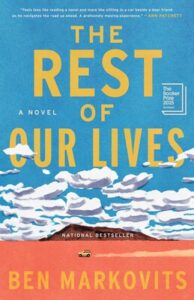
The Rest of Our Lives by Ben Markovits is available from Summit Books, an imprint of Simon & Schuster.



















 English (US) ·
  French (CA) ·
  French (FR) ·