

 2 months ago
65
2 months ago
65
PROTECT YOURSELF with Orgo-Life® QUANTUM TECHNOLOGY
Orgo-Life the new way to the future Advertising by Adpathway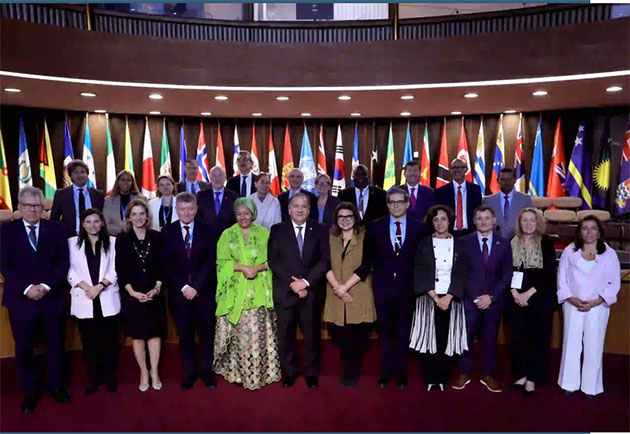 UN Deputy Secretary-General Amina J. Mohammed with Resident Coordinators from the Latin America and Caribbean region. Credit: United Nations
GENEVA, July 2 (IPS) - A letter to staff unions from economists working in the resident coordinator system, blows the whistle on a restructuring that could damage the development pillar and downgrade support to middle income countries.
For memory, UN resident coordinators are tasked with aligning the work of different UN agencies in 162 countries with respective government priorities.
Resident coordinators don’t have funds to get agencies to work together. They rely on their powers of persuasion and importantly, their office’s analytical and data handling capacity.
They therefore have a country economist, who provides evidence-based advice to the UN country team on improving development impact and helps mobilise financing from international financial institutions. These economists also represent non-resident agencies such as mine, UNCTAD, in discussions with the government. As agencies shut their country offices, this becomes more important.
The current system has existed since 2019 and the General Assembly has asked the Deputy Secretary-General, who oversees the system, for a review.
According to the letter (there is no other source of information as the process is a tightly-guarded secret), the proposal is a restructuring that, surprisingly, reduces analytical capacity resident coordinator offices in the over 100 middle income developing countries through a blanket downgrading of economist posts, undermining resident coordinators in the process.
There doesn’t seem to be an assessment in the rushed process of different countries’ circumstances nor the situations they’re going through.
It is not clear why middle-income countries, which constitute most UN member states, are being targeted and this appears to run counter to UN policy.
DESA has warned against abandoning support for middle income countries (https://lnkd.in/edKWFJgM) noting they “are a large and heterogenous group. They differ widely in their development needs and challenges, and in their capacity to mobilise domestic and external resources.”
Rebeca Grynspan has called out the middle-income country trap.
Last month the Secretary-General warned not to judge the challenges facing countries by GDP alone (https://lnkd.in/eaB85QFg).
Although, member states have already voiced concerns with the restructuring; it is being imposed regardless, and being rushed through before they can have a further say.
A large number of staff, originating from all regions, some recruited only last year, will therefore be removed from their posts, while UN support to and ability to mobilise financing for middle income countries will be reduced.
As the restructuring is cost-neutral, the savings from cutting staff in the field would appear to then provide more posts to regional offices and at senior level, and upgrade management posts.
The letter alleges an absence of meaningful consultation with unions and resident coordinators. In some countries, the entire cadre of international and national professional staff in a country could be replaced.
There is consensus that the resident coordinator system should be improved and we know resources are limited. It’s not clear though if downgrading substantive and analytical capacity is the right solution. Perhaps a more comprehensive assessment is needed, without the ticking clock of the end of mandate, so that the fragile development pillar isn’t damaged further.
Extracts from the letter are published below :
We write as economists serving in UN Resident Coordinator’s Offices across Standard, Complex, and Multi-Country settings. We come from different regions, work in countries spanning very different development contexts and income categories, and some of us started our careers as national officers. We raise these concerns in good faith and ask for a structured dialogue before the proposals are finalised.
1. The case for economic expertise in the RC system
The RCO economist provides analytical support independent of government preference and agency programming logic — on fiscal space, debt dynamics, structural transformation, SDG financing, and trade shocks. It draws on experience across multiple country contexts and IFI networks. The seniority of the posts matters: it enables credible engagement with finance ministers, private sector counterparts, and development finance institutions — the partnerships needed to mobilise SDG financing. Abolishing those posts removes that standing. At the ECOSOC OAS in June 2026, delegations spanning the G77, the African Group, AOSIS, India, Germany, Indonesia, Pakistan, Canada, the United States, and the Republic of Korea called explicitly for “strengthening capacities in strategic planning, economic analysis, SDG financing, data, digitalization, communications, climate and resilience.” The recalibration moves in the opposite direction, weeks after that mandate was given.
- The current moment is the wrong time to reduce analytical capacity. Countries face compounding pressures: COVID-19 structural aftereffects, Russia-Ukraine trade and energy disruptions, US-Iran escalation, and a fragmenting multilateral trading system. At the ECOSOC OAS, USG Li Junhua (DESA) noted ODA fell a record 23% in 2025 and the SDG financing gap stands above USD 4 trillion. Agency analytical capacity is simultaneously contracting: UNDP has abolished its economist programme for Africa and budgets and staffing have been cut across multiple entities. As agency footprints shrink, the RCO economist is often the only independent macroeconomic analyst the RC and host government can draw on.
- The Standard RCO category is a coordination label, not an economic complexity assessment. Across the 101 Standard RCO countries, analytical complexity does not track income category. DESA, UNCTAD, and the regional commissions have all cautioned against using GDP per capita as a proxy for development support needs. Applying that filter to determine where independent economic analysis is necessary is inconsistent with the UN’s own guidance.
- Adding senior headquarters posts while cutting country capacity contradicts a direct General Assembly mandate. The recalibration creates new D2 posts at headquarters and increases regional staffing. In December 2025, paragraph 16 of GA resolution A/C.5/80/L.4 requested the Secretary-General to include proposals “with the aim to reduce or reclassify the overall number of USG, ASG, D-2 and D-1 posts markedly” under UN80. Adding D2 posts at headquarters while abolishing and nationalising field posts moves in the opposite direction. Norway at the ECOSOC OAS stated this is “not the time to weaken” the RC system. Member States including AOSIS, Pakistan, Nepal, Indonesia, Canada, and Switzerland also questioned “whether expertise-on-demand can substitute for sustained presence.” It cannot. Cross-country policy and financing work requires continuity, institutional memory, and relationships — not episodic inputs from a regional hub.
- The recalibration contradicts UN 2.0 priorities and discards a recent investment in talent. Under UN 2.0, the Secretary-General prioritised data-driven decision-making — a competency assessed in recruiting these positions — and called for international staff mobility across headquarters, regional bodies, and the field. The RCO economist role was one of the few routes enabling that rotation. Converting posts to national roles closes it off. Several colleagues joined within the past 12 to 18 months on the basis of a clear signal that country-level analytical capacity was being strengthened. Reversing course without explanation wastes the investment and will deter future talent.
2. The analytical basis for this decision does not hold
The recalibration of 130 RCOs has been summarised on a single slide with four columns — no within-category differentiation, no country-specific analysis, no assessment of capacity lost in any specific setting. The UN80 Staff Support Policy Framework (OHR/PG/2025/4, June 2025) requires that “decision-makers must provide reasons for any administrative decisions, supported by facts.” No such reasons have been provided. Income-based categories — which the UN’s own analytical bodies warn against using as a proxy for development complexity — are the primary basis for determining where independent economic analysis is needed.
3. Process concerns
- RCs were not meaningfully consulted. Engagement happened shortly before public rollout, not during the design phase. Earlier discussions reportedly included giving RCs discretion over the economist profile in their office. That option was dropped without explanation, in direct tension with the principle that country team configurations should reflect RC judgment.
- No written rationale has been provided. The town hall did not explain why economist positions are being nationalised or downgraded, why income categories are the organising variable, or how any of this improves efficiency or advances UN 2.0. Without a written rationale, staff and Member States are being asked to accept a significant structural change on trust.
- The process does not meet the Organisation’s own standards for staff consultation. Staff Regulation 8.1(a) requires “effective participation of the staff in identifying, examining and resolving issues relating to staff welfare, including conditions of work.” OHR/PG/2025/4 commits management to engage through the Staff Management Committee “on a regular and timely basis regarding proposals that will impact staff.” Staff learned of this recalibration at a town hall after the configuration was designed. Whatever engagement occurred with staff representatives fell short of these requirements — and staff at large had no involvement at all.
- The pace of implementation risks bypassing Member State oversight. ACABQ and the Fifth Committee will consider RC system funding in autumn 2026. DCO’s extrabudgetary discretion means restructuring can proceed before that review. Rushing this through before a new Secretary-General is named makes the situation harder to revisit.
4. What we are asking for
- A written rationale — including the evidence base, efficiency gains claimed, and an honest account of what analytical capacity is lost.
- Genuine RC consultation before any finalisation on the economist profile appropriate for each country context. RC discretion should be the default, not the exception.
- Structured Staff Council engagement before the configuration is operationalised, consistent with Staff Regulation 8.1 and Staff Rule 8.1(h).
- Reconsideration of the blanket approach, with scope for RCs to retain or request an international economist where conditions warrant — an option reportedly still under discussion before this proposal was finalised.
- An assessment of the HR costs — relocations, repatriations, terminations — given the RC system’s current financial constraints.
Mohammed Chiraz Baly is a staff representative and former General Secretary of the CCISUA staff union federation. He is also a data analyst at UNCTAD focusing on investment financing in developing countries.
IPS UN Bureau
© Inter Press Service (20260702073024) — All Rights Reserved. Original source: Inter Press Service



















 English (US) ·
  French (CA) ·
  French (FR) ·