

PROTECT YOURSELF with Orgo-Life® QUANTUM TECHNOLOGY
Orgo-Life the new way to the future Advertising by Adpathway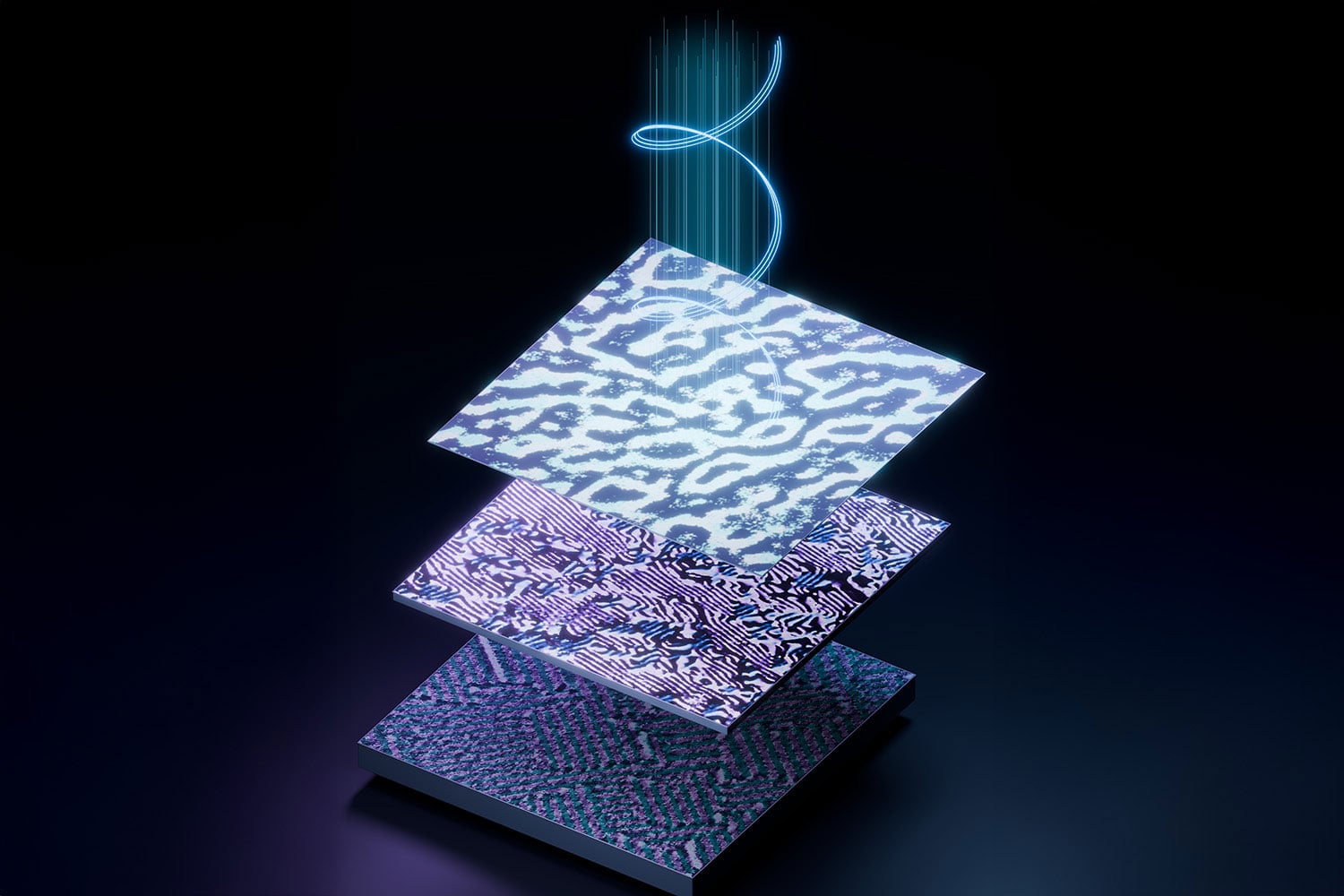 By growing the multiferroic material as part of a three-layer system, researchers have shown that they can eliminate the “dead layer” effect, in which very thin multiferroics lose their desirable electrical and magnetic properties. Credit: Caretta Lab / Brown University
Researchers have overcome a longstanding obstacle that has prevented promising materials from being used in ultra-low-power computer chips.
A promising class of materials could help dramatically reduce the electricity needed for computing, but a persistent problem has kept them out of computer chips. When these materials are made thin enough for modern electronics, the electrical and magnetic properties that make them valuable can disappear.
Researchers at Brown University have now developed a way to overcome this limitation. Their technique produces ultrathin films of bismuth ferrite that retain their essential properties and develop an additional form of magnetism with potential advantages for future computing devices. The findings were published in Nature Materials.
Why Promising Materials Stop Working at Small Scales
Bismuth ferrite belongs to a class of materials called multiferroics, which have interconnected electrical and magnetic properties. Within their crystalline structures, positive and negative charges are displaced in opposite directions, creating electrical polarization. Applying a small voltage can reverse that polarization, allowing information to be stored as binary data (ones and zeros). Because the electrical and magnetic states are linked, the stored information could also be read magnetically, potentially enabling memory and logic devices that consume far less power.
The obstacle is a phenomenon known as the “dead layer” effect. When multiferroic films become extremely thin, their atomic structures and chemical environments can change enough to disrupt their functionality. At the same time, internal electric fields can destabilize their polarization. Together, these effects can eliminate the ferroelectric and magnetic behavior needed for electronic applications.
A New Method Eliminates the Dead Layer
The Brown team addressed both problems by carefully engineering the layers surrounding the bismuth ferrite. First, they grew the material on dysprosium scandate, a rare earth-based crystalline substrate with a smaller lattice spacing than bismuth ferrite. The mismatch places the film under compressive strain, helping preserve the atomic arrangement required for its electrical and magnetic properties.
The researchers also incorporated a metallic layer that screens unwanted electric fields, preventing them from destabilizing the film’s polarization. With both effects controlled, bismuth ferrite remained functional even at thicknesses of only a few angstroms. An angstrom measures approximately four billionths of an inch.
“We’ve established that we can get rid of the dead layer,” said Lucas Caretta, an assistant professor of engineering at Brown who led the work. “We show that you can make this material basically as thin as you want — down to a few angstroms — and it’s still ferroelectric, and it’s still magnetic.”
An Unexpected Magnetic Property Could Improve Future Chips
Beyond preserving the material’s original properties, the engineered structure enhanced its magnetic behavior. The researchers demonstrated that the thin film exhibits altermagnetism, a magnetic state with characteristics that could overcome some limitations of conventional magnetic materials.
“Ferromagnets are useful for memory and logic because they produce strong magnetic signals that are easy to read out,” Caretta said. “The challenge is that they are relatively slow, and their stray magnetic fields make it difficult to pack devices densely on a chip without interference. Antiferromagnets can operate much faster and avoid those stray fields, but their signals are much harder to detect. Altermagnets are kind of the best of both worlds — they can be fast, densely integrated, and still provide a strong electrical signal for readout.”
These characteristics could eventually support faster, more densely packed electronic components while reducing energy consumption. Although the researchers have demonstrated the material’s properties rather than a finished computing device, the technique addresses a major barrier to incorporating multiferroics into practical chips, particularly as artificial intelligence increases demand for computing power.
“We know the underlying properties are already there in the bulk materials,” Caretta said. “The trick is learning how to engineer them into a form that’s useful — and sometimes even better than what nature gives us.”
Reference: “Altermagnetic signatures and topological textures in ultrathin multiferroic BiFeO3” by Geo Fratian, Maya Ramesh, Xinyan Li, Evangelos Golias, Yousra Nahas, Sebastian Maria Ulrich Schultheis, Julian Skolaut, Marti Checa, Arundhati Ghosal, Evan Krysko, Paul Malinowski, Brendan D. Faeth, Jan Priessnitz, F. C. Fobasso Mbognou, Atsushi Hariki, Kosuke Sakurai, Mizuki Furo, Shashank Kumar Ojha, Morgan Congdon, Shiyu Zhou, Alexander Qualls, Kai Litzius, Christoph Klewe, Peter Meisenheimer, Jan Kuneš, Kyle Shen, Laurent Bellaiche, Libor Šmejkal, Darrell G. Schlom, Yimo Han, Sergei Prokhorenko, Ramamoorthy Ramesh, Paul Stevenson, Angela Wittmann and Lucas Caretta, 28 October 2026, Nature Materials.
DOI: 10.1038/s41563-026-02786-1
The research was supported by the U.S. Army Research Office (W911NF-21-2-0162), the National Science Foundation (DMR-2039380, OIA-2327352) and the U.S. Department of Energy (DE-AC02-05CH11231).
Never miss a breakthrough: Join the SciTechDaily newsletter.
Follow us on Google and Google News.
























 English (US) ·
 French (CA) ·
 French (FR) ·