Language Selection

Get healthy now with MedBeds!
Click here to book your session

Protect your whole family with Orgo-Life® Quantum MedBed Energy Technology® devices.

Advertising by Adpathway


 Advertising by Adpathway

On this day in space! Nov. 1, 1962: The Soviet Union Launches Mars 1 spacecraft to Red Planet during the Space Race

8 hours ago 4

PROTECT YOURSELF with Orgo-Life® QUANTUM TECHNOLOGY

Orgo-Life the new way to the future

  Advertising by Adpathway

Follow us

Add us as a preferred source on Google

On Nov. 1, 1962, the Soviet Union launched the Mars 1 spacecraft on a mission to fly by the Red Planet.

While it did end up flying by Mars, the mission was not exactly a success. After it separated from the rocket, it deployed its solar panels and started cruising toward Mars.

When mission controllers were checking out the telemetry it transmitted back to Earth, they found out that Mars 1 had sprung a leak in one of the gas valves that controls the spacecraft's orientation. And without a working orientation system, Mars 1 would have a hard time pointing its antennas in the right direction. It lost contact with Earth when it was about halfway to Mars.

A model of Mars 1, a Mars flyby spacecraft launched to the Red Planet by the Soviet Union on Nov. 1, 1962.

A model of Mars 1, a Mars flyby spacecraft launched to the Red Planet by the Soviet Union on Nov. 1, 1962. (Image credit: NASA)

Why it mattered

Ever since Galileo Galilei pointed his telescope to the red-tinted star and identified as a planet, Mars has captivated scientists' interests as to its nature. So it was of no surprise that as soon as we gained the ability to send missions into space, that the focus turned to the "fourth rock from the Sun."

As it turned out, though, reaching Mars, let alone entering its orbit or landing on its surface,, was and continues to be difficult.

Mars 1, despite its name, was actually the Soviet Union's fourth attempt at sending a probe to the planet. The first three ended in launch failures. Similar problems faced the United States, as well, but it was NASA's Mariner IV mission that became the first to successfully fly by Mars two years later.

Still, as humanity continues to push forward to the day people land on, explore and live on Mars, the 1962 Soviet mission stands as the first to get close to revealing the first details about the planet.

Want more space history? Check out our full On This Day In Space Story archive and watch our On This Day In Space videos on YouTube.
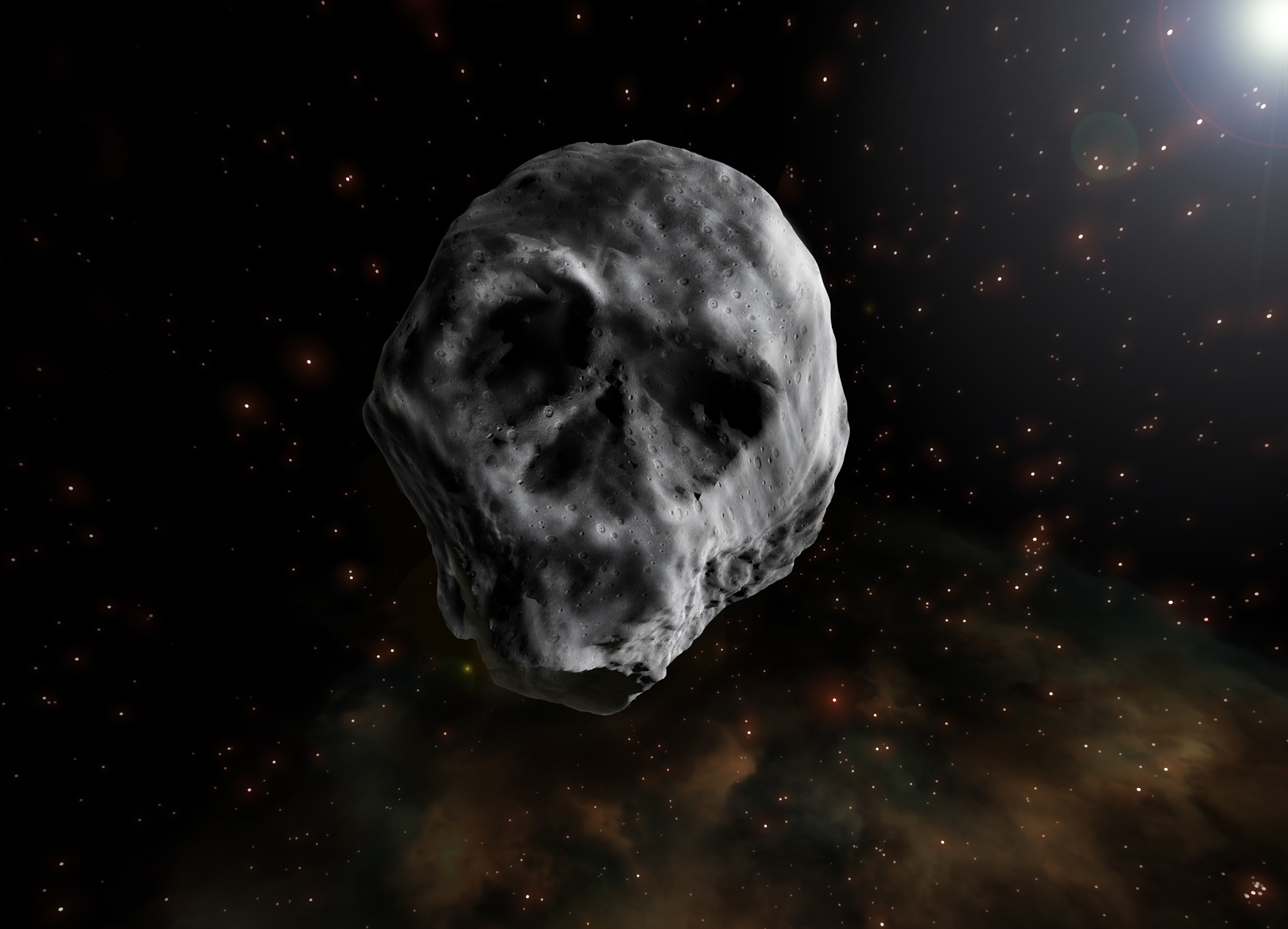

An artist's illustration of the Halloween Asteroid 2015 TB145, which looks much like a skull from certain angles. The asteroid flew harmlessly by Earth on Oct. 31, 2015 and will return in November 2018.

Hanneke Weitering is a multimedia journalist in the Pacific Northwest reporting on the future of aviation at FutureFlight.aero and Aviation International News and was previously the Editor for Spaceflight and Astronomy news here at Space.com. As an editor with over 10 years of experience in science journalism she has previously written for Scholastic Classroom Magazines, MedPage Today and The Joint Institute for Computational Sciences at Oak Ridge National Laboratory. After studying physics at the University of Tennessee in her hometown of Knoxville, she earned her graduate degree in Science, Health and Environmental Reporting (SHERP) from New York University. Hanneke joined the Space.com team in 2016 as a staff writer and producer, covering topics including spaceflight and astronomy. She currently lives in Seattle, home of the Space Needle, with her cat and two snakes. In her spare time, Hanneke enjoys exploring the Rocky Mountains, basking in nature and looking for dark skies to gaze at the cosmos. 

Read Entire Article


Start the new Vibrations with a Medbed Franchise today!  

Protect your whole family with Quantum Orgo-Life® devices

  Advertising by Adpathway