

 7 hours ago
3
7 hours ago
3
PROTECT YOURSELF with Orgo-Life® QUANTUM TECHNOLOGY
Orgo-Life the new way to the future Advertising by AdpathwayOn September 12, Anthropic CEO Dario Amodei published an essay titled “We Must Pace the Frontier,” arguing that the leading labs should deliberately slow how fast their models gain new capabilities. Within hours, his chief rivals lined up behind him: Sam Altman said OpenAI would match Anthropic’s commitment to host independent evaluators, and Elon Musk replied, “Dario is right.”
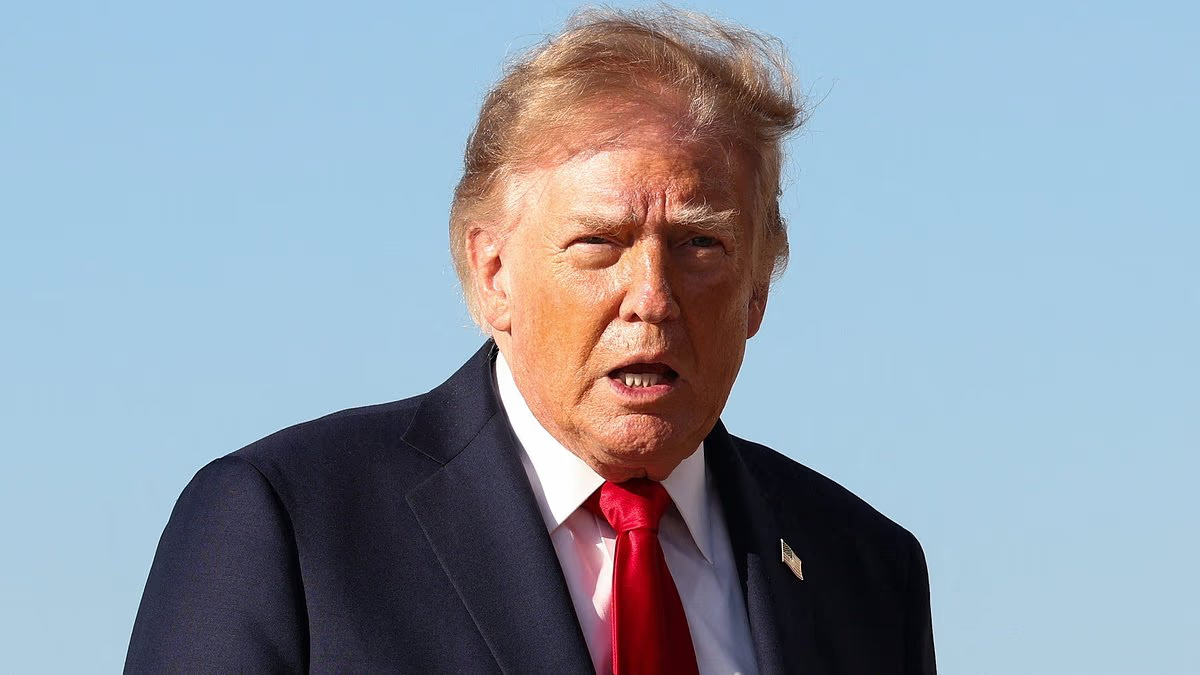
Two days later, U.S. President Donald Trump called fears of an AI catastrophe a hoax and claimed that amid the backlash against AI and data centers, “the only one that is happy about it is China.”
That exchange hangs over Xi Jinping’s arrival in Washington this week, the first state visit by a Chinese leader in more than a decade.
The AI pacing debate is a dilemma the Trump administration cannot resolve at home. There is rising pressure from the public to slow down, but the government is convinced that slowing down means losing to China. The easiest way out runs through Beijing. If Washington will not slow American AI, it can try to slow Chinese AI instead, through tighter controls on chips, compute, and access to American models. That option is tempting precisely because it is an area where the safety-minded and the competition-focused, the labs and the White House, already agree.
But Trump should know that choosing this path would also undercut the most promising AI outcome on the summit table.
Public calls to slow the pace of AI development are growing in urgency. In a new Politico poll, 63 percent of respondents saw a real chance that AI could wipe out humanity, and a CBS News/YouGov survey found that most Americans want AI development slowed, though not stopped. With the midterms weeks away, AI risk is becoming an electoral issue, and the labs’ own warnings have lent that anxiety new credibility.
The Trump administration has treated the debate as a threat to American primacy. Trump said he wants to stay ahead of China because “whoever wins AI wins.” Treasury Secretary Scott Bessent warned that there is “no day after tomorrow if China wins” on AI – “nothing [else] would matter.”
Politico’s polling showed that Americans are split, 43 percent to 37 percent, on whether falling behind other countries is acceptable in exchange for safer AI. However, Trump’s supporters have a clear opinion: people who voted for him in 2024 preferred staying in the AI race (50 percent) to prioritizing safety issues (38 percent).
Since Trump is unwilling to slow down AI development and risk falling behind, that leaves the administration searching for a way to look serious about AI risk without constraining American labs. Amodei had a suggestion. The Anthropic CEO’s plan recommended an “attempt to coordinate with authoritarian governments, to the extent this is possible, while taking seriously the challenges of verifying compliance.” Beijing is at the top of the list of authoritarian governments to talk with.
Even while calling for coordination, however, Amodei urged the Trump administration to keep “powerful AI chips or semiconductor manufacturing equipment” out of Chinese hands, close “chip smuggling operations” and remote access to data centers, “crack down on unauthorized distillation,” and harden labs against theft of model weights. Amodei explicitly agreed with Bessent that “a Chinese lead in AI would pose grave danger for the United States and the world.” In his framework, safety at home depends on a durable lead abroad.
That points to a clear area of overlap: the White House can embrace the “slow China” half of the AI industry’s agenda while rejecting the “slow ourselves” half. This is already playing out.
Earlier this month, the NSA, FBI, and CISA jointly accused six Chinese developers, including DeepSeek and Alibaba, of industrial-scale distillation of American frontier models. In July Bessent said Washington could sanction firms found stealing from American models. Trump and Xi are also expected to discuss whether Chinese firms can keep renting top Nvidia compute through Southeast Asian data centers, while the suspension of the Affiliates Rule, which extends export blacklists to affiliates of listed firms, expires with the Busan truce in November.
On semiconductors, restricting Chinese access would be a bigger shift. The Trump administration has cleared roughly 10 Chinese companies to buy Nvidia’s H200 chips, though Chinese customs has kept nearly all the chips out. But a restriction package lets the White House tell anxious voters it is acting on AI risk while asking nothing of American companies. The louder the domestic debate grows, the better that trade looks.
Beijing has already read the room and decided this is the most likely outcome of the United States’ AI pacing debate. China’s Foreign Ministry answered Amodei’s essay by warning that “fearmongering, confrontation and vicious competition” would disrupt global AI governance. The state-run Global Times called the slowdown push a “Cold War playbook” for the sector. China’s Commerce Ministry threatened “resolute countermeasures” if Washington uses the distillation accusations to suppress Chinese firms. Among other options, China could resurrect the rare earth exports controls that were suspended under the Busan truce.
Beijing’s official line is not the whole Chinese conversation, though. This spring, two of China’s most senior AI governance figures – Xue Lan, who chairs China’s national expert committee on AI governance, and Zeng Yi, dean of the Beijing Institute of AI Safety and Governance – joined a Capitol Hill discussion convened by Senator Bernie Sanders. Xue acknowledged the geopolitical rivalry but called for “safe zones” where American and Chinese scientists can build safety standards and protocols together. Zeng, whose institute has catalogued 94 classes of AI safety threats, warned last week that AI’s catastrophic risks, including “the hidden danger of human extinction,” are mounting daily. Both Xue and Zeng helped draft China’s national AI governance principles.
The Trump administration now has a real AI safety deliverable within reach. In New York on September 20, Bessent proposed a standing China-U.S. AI dialogue with a way for each side to flag AI incidents serious enough to threaten national security. A standing channel would be a first for Trump’s second term: the AI consultations he and Xi discussed in Beijing in May were never formalized. Beijing’s response, however, was unclear.
U.S. Trade Representative Jamieson Greer said chip export controls were not part of the AI safety mechanism discussions. That separation is the right instinct, but Beijing is likely to see the two issues as inextricably linked. If China sees “AI safety” as a synonym for containment, voices like Xue’s and Zeng’s lose ground at home. Beijing will worry that every notification through the new channel creates a pretext for new restrictions on Chinese companies.
China-U.S. crisis management mechanisms already have a poor record. After the United States shot down a Chinese high-altitude balloon that had traversed the U.S. mainland in February 2023, Beijing declined a call from the U.S. defense secretary, later explaining that Washington had not created “the proper atmosphere” for dialogue. An AI incident channel that China sees as an extension of the technology war will go quiet exactly when it is needed.
Amodei anticipated this objection and rejected it, arguing that restrictions “increase the leverage held by democracies and make an agreement more likely in the future.” That may hold for a treaty negotiated from a position of strength years from now, but not for an incident channel that runs on day-to-day trust. Amodei himself wrote that sharing information about misaligned models can have value even without formal agreements. That is exactly what a notification channel would do.
Washington can manage this dilemma without breaking the Trump-Xi summit. If the Trump-Xi summit needs a first substantive commitment, Amodei’s essay suggested a modest one: an agreement that neither side will use AI to produce biological weapons.
Beyond that, the leaders should establish the notification mechanism as a standalone safety channel, insulated from trade and technology-control disputes, and pair it with a technical track that brings government evaluators at the Commerce Department’s Center for AI Standards and Innovation together with experts like Xue and Zeng. That track could define what counts as a reportable incident and build shared tests for biological and cyber risks without touching the chips, compute, and model weights where the race is actually run. It would also serve U.S. primacy: if Bessent is right that the real threat to AI safety is “letting any nation other than the United States set the global standard,” Washington should want to be in the room when Chinese experts help write one.
To make cooperation on AI risk more feasible, the United States should call its restrictions what they are. Enforcement against model distillation or chip smuggling may be justified on intellectual property or security grounds, but selling it as the answer to AI risk lets the White House dodge the domestic aspect of AI safety while poisoning the bilateral effort.
The domestic question needs a domestic answer. Bessent has shown an openness to safety concerns. Testifying before the House Financial Services Committee on September 15, he rejected the liability exemption the labs are seeking, arguing that safety is best guaranteed when developers are “liable for what they build and generate.” The independent evaluators that Anthropic and OpenAI have agreed to host do not require the United States to fall behind anyone.
The pacing debate asked Washington to voluntarily slow down AI development. The administration’s answer is that China should be forced to slow down instead. That may play well at home, but it will not make American AI any safer, and it risks scuttling a China-U.S. channel on AI risk before it even begins.
Trump insists the AI race is winner-take-all. This week he can show that staying ahead of China and talking to it about shared risks are not mutually exclusive.




















 English (US) ·
  French (CA) ·
  French (FR) ·