

 9 hours ago
4
9 hours ago
4
PROTECT YOURSELF with Orgo-Life® QUANTUM TECHNOLOGY
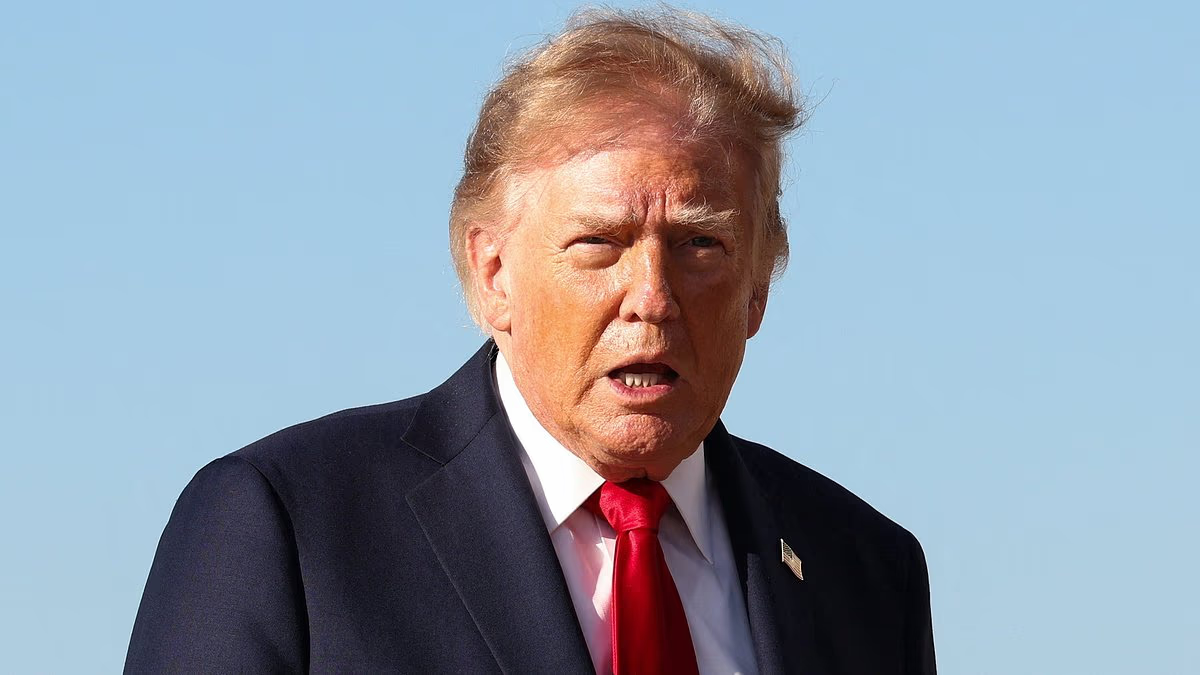
Orgo-Life the new way to the future Advertising by AdpathwayLast month, U.S. President Donald Trump posted on Truth Social that “I recently asked the President of South Korea if they would like to join us in the Denuclearization of the Islamic Republic of Iran, and they said, ‘No thanks!’” He has publicly called for Seoul’s participation in the U.S. war with Iran since March, and in this post, he explicitly expressed his dissatisfaction with South Korea’s refusal to participate. Trump also attached consequences: in the same post, he announced the scaling down of annual South Korea-U.S. joint military exercises and expressed a strong affinity with North Korean leader Kim Jong Un.
Trump has continued to press Seoul on the Iran conflict. The South Korean government is reportedly considering various military and non-military options, including the deployment of military assets, to Hormuz. A government inspection team was even sent to the United Arab Emirates to assess security and operational conditions for a potential deployment.
Yet, South Korean President Lee Jae-myung clearly drew a line on the scope of South Korea’s military involvement. In a press conference on September 18, Lee announced that “there will be no deployment that involves or intervenes in the war,” but he added that South Korea should undertake “minimum measures to protect its commercial vessels, crude oil shipping routes, and the lives and safety of its citizens, as other countries are doing.”
Seoul has previously sent troops to support U.S. military operations in the Middle East.
In 2003, Seoul announced that it supported Washington’s war in Iraq and sent engineering and medical units. Upon a U.S. request for additional troops, and following approval by the National Assembly, then-President Roh Mooh-yun sent additional troops, in part to reinforce the South Korea-U.S. alliance at a time when Seoul was seeking Washington’s cooperation on the North Korean nuclear issue. Despite strong domestic opposition, between 2003 and 2008, approximately 4,000 South Korean soldiers were deployed to Iraq for security, reconstruction, medical support, and other non-combat missions.
Currently, Seoul once again needs Trump to play a “peacemaker” role in resuming talks with North Korea and addressing Pyongyang’s nuclear program. However, Lee has far less room than Roh did in 2003 to use overseas troop deployment as a means of strengthening cooperation with Washington. The current international and domestic situations both make such a deployment difficult for Lee.
First, compared to the Iraq War, the current confrontation with Iran rests on a less developed and less institutionalized legal framework. Prior to the 2003 Iraq War, the U.S. Congress passed H.J. Res. 114, authorizing then-President George W. Bush to use military force against Iraq in 2002. The United Nations Security Council then adopted Resolution 1441, which gave the Saddam Hussein government “a final opportunity to comply with its disarmament obligations regarding Iraq’s weapons of mass destruction,” although whether the resolution authorized the use of force remains highly contested. After the collapse of the Iraq regime, the UNSC adopted Resolutions 1511 and 1546 to support Iraq’s peace political transition. Against this broader domestic and international framework, the U.S.-led “coalition of willing,” consisting of 49 countries, supported the war with varying military and non-military contributions.
In the current war neither the U.S. Congress nor the U.N. Security Council have authorized the use of force against Iran. Furthermore, except for Israel, all other U.S. allies have refrained from directly joining the war. NATO officially refused “any collective military action under Article 5.” The United Kingdom and France are preparing to lead “an independent and strictly defensive multinational military mission” for the freedom of navigation through the Strait of Hormuz.
During the war in Iraq, it took about three weeks to effectively bring down the Saddam Hussein government. Today, the Iranian government and the Islamic Revolutionary Guard Corps remain intact nearly seven months after Israeli-U.S. strikes began. For Seoul, this means the deployment of South Korean troops would create both higher diplomatic costs with Tehran and greater security risks.
To make sure Seoul knew this, Iranian Foreign Ministry spokesperson Esmaeil Baghaei took the unusual step of posting a warning in Korean on X. “Any other country’s military presence or participation in operations in the Persian Gulf and the Strait of Hormuz can only be regarded as direct support for the party responsible for the aggression and will have serious consequences,” the statement said.
This Korean-language post is widely understood as a warning over Seoul’s potential deployment. A South Korean military presence in Hormuz could expose its forces to potential Iranian retaliation.
These external factors are less conducive to South Korean deployment than during the Iraq war. But what makes Lee’s decision even more difficult is domestic opposition. Military involvement in the Iran war could put his political standing at risk.
At the time of the deployment to Iraq, many South Koreans opposed the Roh government’s decision. Critics cited Article 5, Paragraph 1 of the Constitution, which states that “The Republic of Korea shall… renounce all aggressive wars.” Public opposition intensified after the killing of South Korean civilian Kim Sunil by a terrorist group demanding that Seoul cancel the additional troop deployment. By June 2004, 56 percent of South Koreans opposed the deployment, and Roh, just 16 months into his term, saw his approval rating fall to 28.2 percent.
Lee is already facing a declining approval rating, which just hit a record low of 38 percent. Currently, the public disapproval is largely due to domestic issues. That means Lee can ill-afford to make an unpopular foreign policy decision – and taking an active role in the Iran war would be just that. In a recent survey, 55 percent of South Koreans opposed a potential deployment to Hormuz, while 32 percent supported it. Last weekend, more than 500 civic and religious groups took to the streets against the potential deployment.
Roh suffered the political consequences of deploying to the Middle East back in the early 2000s. Given Lee’s already-declining approval rating and steep public opposition, a decision to deploy troops could impose even more substantial political costs on the Lee administration, which is just over a year into its five-year term.
Given these international and domestic difficulties, Lee will have a hard time convincing the South Korean public to support the deployment of troops to Hormuz, no matter how much pressure Trump applies.
Rather than allowing the Iran war to overshadow the relationship, Seoul and Washington should pay more attention to areas that can bring tangible benefits to both countries. It is time to focus on consequential areas of cooperation including shipbuilding, semiconductors, and nuclear energy, all places where the national interests of both South Korea and the U.S. converge.

















 English (US) ·
  French (CA) ·
  French (FR) ·