

 1 month ago
54
1 month ago
54
PROTECT YOURSELF with Orgo-Life® QUANTUM TECHNOLOGY
Orgo-Life the new way to the future Advertising by Adpathway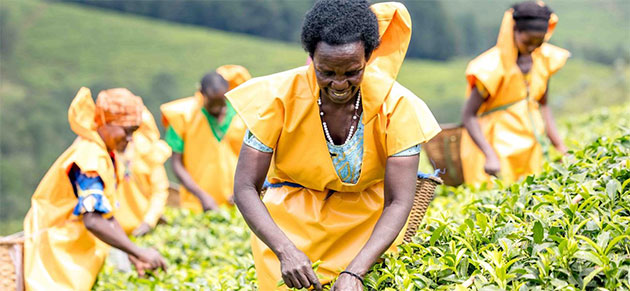 Woman farmers harvest tea leaves at a tea plantation in Nyaruguru, Kibeho District, Rwanda. Tea is one of Rwanda’s major agricultural export commodities.Credit: FAO / Jean Baptiste Nkurunziza
UNITED NATIONS, July 9 (IPS) - As FAO coordinates the implementation of the International Year of the Woman Farmer 2026, gender team leader Tacko Ndiaye discusses why investing in Africa’s women farmers is essential for food security, economic growth and creating more resilient agrifood systems
Africa Renewal: What role do women farmers play in ensuring food security in Africa?
Ms. Ndiaye: We know that women are at the heart of Africa’s agrifood systems. Across the continent, women play a central role in agrifood systems through their labour, expertise and care, supporting households, communities and local markets.
Women make up almost half of the agrifood workforce—49 per cent—and contribute at every stage of the value chain, from production and processing to distribution and trade, according to FAO’s recent report, The Status of Women in Agrifood Systems in Sub-Saharan Africa.
Also, women are custodians of culture and keepers of traditional knowledge passed down through generations about seed preservation and protecting biodiversity, as well as maintaining the social bonds that underpin the agrifood sector.
At the same time, Sub-Saharan Africa continues to face multiple food insecurity challenges. To give you an example, in 2024, about 64 per cent of the population in Sub-Saharan Africa experienced moderate or severe food insecurity, according to FAO data. We also know that more than 30% of women aged 15 to 49 years are experiencing anemia in the region.
If Africa is to address its food security challenges, empowering women farmers must be a priority.
What are the most pressing challenges women farmers in Africa face today?
In Africa, as you know, women till the land. Every time you see a publication on agriculture and food systems in Africa, you are more likely to see a photo of a woman farmer on the front page.
Yet despite their central role, women continue to face structural inequalities that limit their productivity, resilience and economic opportunities.
- One of the most significant barriers women face is unequal access to and control over land. In 28 of the 32 Sub-Saharan African countries we studied, men are more likely than women to own or control agricultural land. In more than 40 per cent of those countries, the gender gap in ownership or secure rights over agricultural land is particularly pronounced.
- We also know that even where there is law to protect land rights, such legal protections are either weak or insufficient. In half of the countries we studied, legislation does not adequately protect women’s land rights.
- Land ownership is also closely linked to access to finance because land is often used as collateral. Yet only 49 per cent of women in the region have a financial account, compared with 61 per cent of men.
- Women also face barriers in accessing agricultural inputs, extension services, markets and technology.
- Digital exclusion is another challenge. Digital platforms have become essential for marketing products, accessing information and acquiring new skills. Yet women are 29 per cent less likely than men to use mobile internet. An estimated 205 million women in Sub-Saharan Africa still lack access to digital tools.
- In addition, despite their substantial contributions to agrifood systems, women often work under poorer conditions than men. They are disproportionately represented in precarious, informal, labour-intensive, lower-skilled and underpaid jobs. This is reflected in the fact that nearly 90% of women in the region work in the informal sector.
- Discriminatory social norms, gender-based violence, restrictions on women’s leadership and participation, and the heavy burden of unpaid care work further limit their opportunities.
There are many challenges that need to be addressed if we are to build agrifood systems that are more inclusive, resilient and efficient.
Source: Africa Renewal, United Nations
IPS UN Bureau
© Inter Press Service (20260709054150) — All Rights Reserved. Original source: Inter Press Service

















 English (US) ·
  French (CA) ·
  French (FR) ·