

 5 hours ago
2
5 hours ago
2
PROTECT YOURSELF with Orgo-Life® QUANTUM TECHNOLOGY
Orgo-Life the new way to the future Advertising by AdpathwayKey Facts
- CSN ADR surged 8.65% to US$1.13, the strongest one-day gain among major Latin American steel names on Tuesday, September 1, 2026.
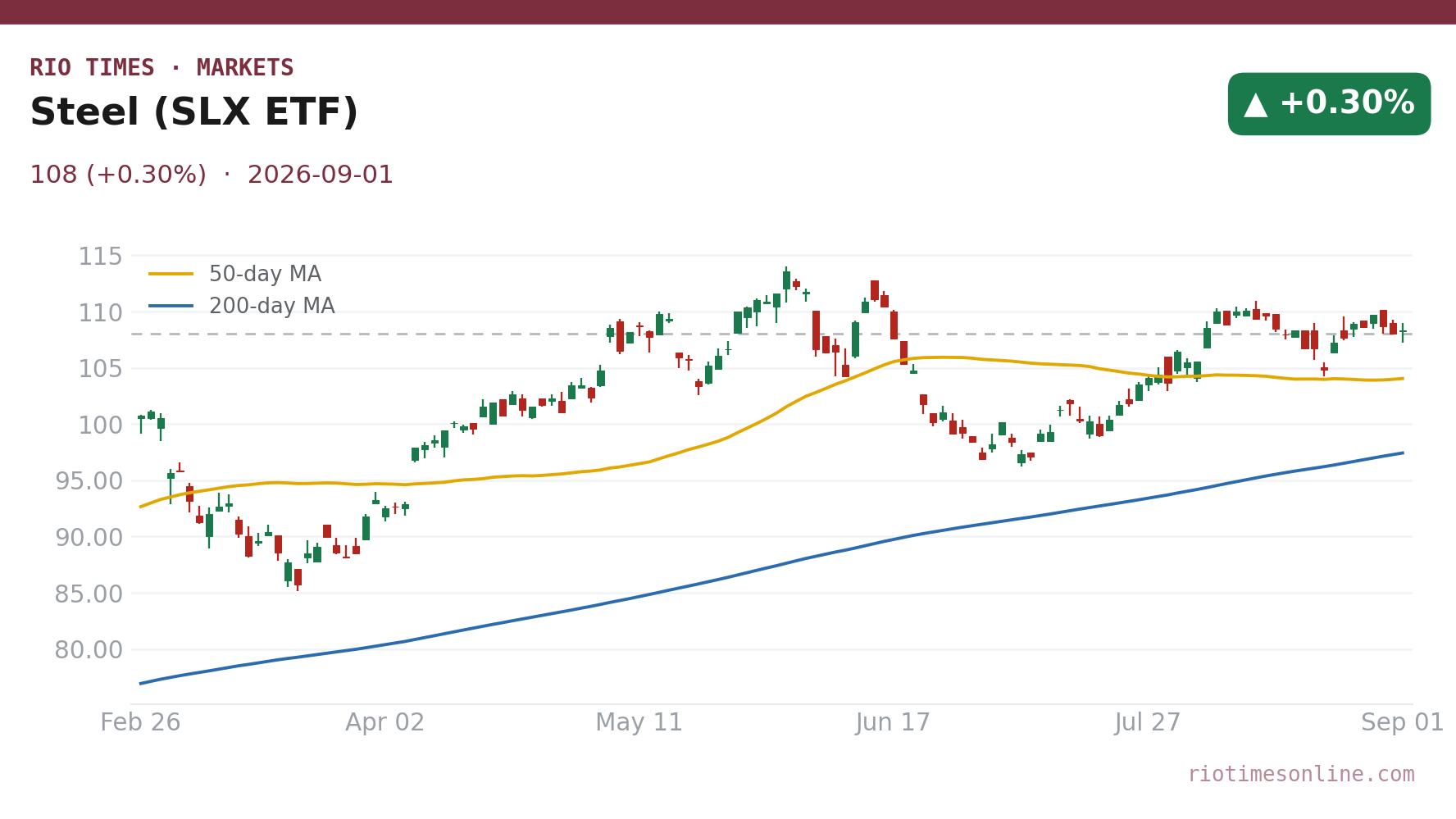
- Gerdau shares rose 1.74% to US$4.69, modestly outperforming the SLX steel-producers ETF, which added 0.30% to US$108.34.
- Ternium advanced 1.55% to US$55.67, reflecting Mexico’s tariff wall of up to 50% on non-FTA steel products and USMCA-linked auto demand.
- Chinese steel holds 45.4% share of Latin America’s steel imports, keeping regional import penetration near 39.7% of consumption in 2025 despite tariff walls.
- Brazil first-half import penetration hit 22.5% well above historical norms, while a 25% tariff on above-quota imports of 19 steel products runs through June 2027.
- Latin American apparent steel consumption was barely growing, up just 0.1% year on year to 6.5 million tonnes in March 2026, with Alacero projecting only 0.5% growth for the full year.
Today’s Focus
Latin American steel shares closed mostly higher on Tuesday, September 1, 2026, with CSN’s New York-traded ADR jumping 8.65% to US$1.13, the standout move among regional producers. Gerdau added 1.74% to US$4.69, while Ternium rose 1.55% to US$55.67. The global steel-producers ETF SLX finished up 0.30% at US$108.34.
The rally sits atop a defensive policy floor: Brazil maintains a 25% tariff on above-quota imports of 19 steel products through June 2027 and five-year anti-dumping duties on Chinese cold-rolled, coated and hot-dip galvanised flat steel. Mexico applies tariffs of up to 50% on 1,463 non-free-trade-agreement products, including steel, layered on a 25% levy in place since August 2023.
Yet the fundamental pressure has not disappeared. Chinese mills supplied 45.4% of Latin America’s steel imports in 2025, and regional import penetration approached 39.7% of consumption. Brazil’s first-half 2026 penetration of 22.5% remains far above historical norms.
Demand is tepid rather than collapsing. Latin American apparent rolled steel consumption rose just 0.1% year on year in March 2026, while automotive output grew 1.1% in the first four months. Ternium is guiding for Mexican steel demand growth of about 4% in 2026, anchored in nearshoring and infrastructure.
What matters today. CSN’s 8.65% surge shows investors rewarding tariff-shielded Brazilian mills even as Chinese import penetration keeps margins structurally compressed.
01 The session in one read
CSN’s American depositary receipt was the clear winner among Latin American steel shares on Tuesday, September 1, 2026, jumping 8.65% to US$1.13. The move marked the strongest one-day gain for any major regional producer in the session and came without a single company-specific announcement.
Gerdau closed at US$4.69, up 1.74%, and Ternium ended at US$55.67, up 1.55%. All three names outpaced the broader steel-producers ETF SLX, which added just 0.30% to US$108.34.
Assessment — Tariff relief, Chinese volume pressure MEDIUM
The equity moves on Tuesday, September 1, 2026 reflect a market that sees tariff protection as durable but not sufficient to restore pricing power. CSN’s outsized gain likely captures short-covering and relief that the Brazilian duty framework remains intact through mid-2027, while Gerdau and Ternium posted steadier, demand-linked advances. The variable to watch is whether Latin America’s quarterly import penetration stays near the 22.5% Brazilian reading or climbs back toward the 39.7% regional import penetration seen in 2025.
02 The board
The price board showed a clear Brazilian tilt. CSN’s +8.65% leap to US$1.13 dwarfed Gerdau’s +1.74% gain to US$4.69, suggesting investors treated the former as a higher-beta play on the country’s tariff-protected flat-steel complex.
Ternium’s +1.55% rise to US$55.67 kept the Mexican producer within striking distance of its recent range. The SLX ETF, a basket of global steel producers, settled at US$108.34, up 0.30 percent, confirming that Latin American names led rather than followed the global steel sector.
| Steel (SLX ETF) | US$108.34 | +0.30% |
| Gerdau | US$4.69 | +1.74% |
| CSN (ADR) | US$1.13 | +8.65% |
| Ternium | US$55.67 | +1.55% |
Source: RT close, 2026-09-01. Where a commodity has no spot feed, an exchange-traded tracker or leading producer is shown as a labelled proxy.
Live Market IntelligenceThe live market boardInside: market breadth, the sector heatmap, currencies & rates, the Latin America scoreboard and the full instrument board.Rio Times · Live Market Intelligence
Latin America — Cross-Market Board
Regional
Sep 2, 2026 · 05:38
Ibovespa · benchmark
179,722.48 +1.30%
L 167,142day rangeH 168,310
+21.85% over 12 months
Market breadth · 5 names
60% advancing
3 ▲ advancing2 declining ▼
Currencies, rates & key inputs
Latin America scoreboard
IndexLastTodayStrength
IbovespaBrazil 179,722.48 +1.30%
S&P/BMV IPCMexico 65,314.78 -0.18%
S&P IPSAChile 11,315.26 -1.14%
S&P MERVALArgentina 3,049,455 +0.51%
MSCI COLCAPColombia 2,470.26 +1.86%
BVL S&P PerúPeru 59,450.29 +0.11%
Full instrument board
| IBOV | 179,722.48 | +1.30% | +21.85% | 177,418.78 | 168,310 | 167,142 | — |
| IPSA | 11,315.26 | -1.14% | — | 11,445.90 | 11,210 | 10,984 | 1,513,213,483 |
| IPC MEX | 65,314.78 | -0.18% | +12.17% | 65,430.32 | 66,121 | 65,405 | 108,886,187 |
| MERVAL | 3,049,455 | +0.51% | +30.51% | 3,022,485 | 3,042,365 | 2,991,150 | — |
| COLCAP | 2,470.26 | +1.86% | — | 9.04 | 9.05 | 9.02 | 4,133 |
| BVL PERÚ | 59,450.29 | +0.11% | — | — | — | — | — |
| USD/BRL | 5.16 | +0.01% | -5.13% | 5.16 | 5.18 | 5.14 | — |
| EUR/BRL | 5.95 | +1.01% | -5.83% | 5.89 | 5.98 | 5.94 | — |
| USD/MXN | 17.06 | -0.24% | -8.58% | 17.10 | 17.08 | 17.01 | — |
| USD/CLP | 913.98 | +0.04% | -5.67% | 913.65 | 915.11 | 906.68 | — |
| USD/COP | 3,140 | +0.03% | -22.04% | 3,139 | 3,141 | 3,105 | — |
| USD/PEN | 3.36 | -0.66% | -4.82% | 3.38 | 3.38 | 3.35 | — |
| USD/ARS | 1,493 | +0.10% | +12.96% | 1,491 | 1,494 | 1,480 | — |
| USD/UYU | 40.27 | +1.24% | +1.80% | 39.77 | 40.27 | 40.23 | — |
| USD/PYG | 5,939 | +1.68% | -19.54% | 5,841 | 5,939 | 5,925 | — |
| USD/BOB | 11.64 | -0.76% | +72.04% | 11.73 | 11.72 | 11.64 | — |
| USD/DOP | 58.34 | +1.25% | -3.44% | 57.62 | 58.34 | 58.04 | — |
| USD/CRC | 445.92 | +0.89% | -9.71% | 441.97 | 448.50 | 445.92 | — |
Largest moves today
COLCAP 2,470.26 +1.86%
USD/PYG 5,939 +1.68%
IBOV 179,722.48 +1.30%
USD/DOP 58.34 +1.25%
USD/UYU 40.27 +1.24%
IPSA 11,315.26 -1.14%
EUR/BRL 5.95 +1.01%
USD/CRC 445.92 +0.89%
The session read
The Ibovespa rose 1.30%, with breadth positive — 3 of 5 names higher. COLCAP led, while IPSA lagged.
G
◆ Live Company Intelligence
Gerdau
SA: GGBR4GGBR4Basic MaterialsSteel30,000 employees
Valuation & profitability
Market capR$46.58B
Revenue (TTM)R$69.54B
P / E ratio20.6
Profit margin3.2%
Return on equity4.2%
Price & risk
52-wk low
$15.7852-wk high
$26.44
Beta (volatility)0.91
200-day average$21.80
Revenue trend · 6y
20202025
Latest R$69.86B
Ownership
Institutions48.4%
Shares outstanding1.25B
Dividend
Yield3.3%
Payout ratio26.3%
Fwd. annual$0.92
What Gerdau does. Gerdau S.A., together with its subsidiaries, operates as a steel producer company. It operates through Brazil Business, North America Business, and South America Business segments. The company offers rebars, bars, wires, thick plates, hot rolled coils, billets, blooms, plates, wire rods, and structural profiles. It also provides special steel products for agricultural,…
03 What moved it
The single largest driver remains policy: Brazil’s 25% tariff on above-quota imports of 19 steel products, renewed through June 2027, plus five-year anti-dumping duties on Chinese cold-rolled, coated and hot-dip galvanised flat steel. These measures shield the domestic price lists of Gerdau, CSN and Usiminas.
Mexico offers a parallel wall. Tariffs of up to 50% on 1,463 products from countries without a free-trade agreement, including steel, sit alongside a 25% levy on non-FTA steel in force since August 2023. Ternium, the main Mexican flat-steel producer, is the principal beneficiary.
Against that protection, the pressure from cheap Chinese tonnage is unrelenting. Chinese mills accounted for 45.4% of Latin America’s steel imports in 2025, helping push regional import penetration toward 39.7% of consumption, and Brazil’s own first-half 2026 penetration remains elevated at 22.5%.
04 The Latin American read
For a foreign investor, the region’s steel trade is a story of two layers. The first is a politically entrenched tariff regime that keeps domestic mills from being undercut on price, which is why CSN can rise 8.65% in a single session without a profit warning or an upgrade.
The second layer is volume. Latin American apparent rolled steel consumption grew only 0.1% year on year to 6.5 million tonnes in March 2026, and Alacero projects full-year apparent consumption growth of just 0.5% to 75.6 million tonnes. Construction is broadly flat, while automotive output rose 1.1% in the first four months of 2026.
05 The names to watch
CSN is the volatility leader: its ADR trades at a low absolute price, so small changes in import data or tariff rhetoric produce outsized percentage swings. The company is also the most exposed to flat-steel competition from Chinese cold-rolled and coated product.
Gerdau offers a steadier profile, with long-steel exposure tied directly to construction and infrastructure spending across Brazil and the Americas. Its 1.74% gain on Tuesday, September 1, 2026 suggests investors see demand holding rather than accelerating.
Ternium is the Mexican bellwether. Management guides for Mexican steel demand growth of about 4% in 2026, anchored in infrastructure projects, nearshoring-related factory construction and USMCA-linked auto orders, even as total consumption remains below 2023 levels.
06 The outlook
The path forward hinges on whether tariff walls can hold back Chinese tonnage while demand improves from its near-flat trajectory. Brazil’s 22.5% first-half import penetration is the clearest warning that protection has not solved the problem. If automotive output keeps rising at 1.1% and Ternium’s 4% Mexican growth forecast proves accurate, regional mills can defend margins; if Chinese imports climb further, the tariff-shielded rally in names like CSN will look fragile.
07 What to watch
- Brazil import penetration: Whether the 22.5% first-half 2026 reading falls toward historical norms or climbs back toward the 39.7% regional share.
- Chinese export pricing: Cheap Chinese cold-rolled and coated steel remains the central margin threat despite Brazil’s anti-dumping duties.
- Mexican nearshoring demand: Ternium’s 4% growth guidance depends on infrastructure and USMCA-linked auto orders materialising.
- Regional auto output: The 1.1% year-on-year rise in Latin American automotive production is the main demand floor for flat steel.
Frequently Asked Questions
Why did CSN jump 8.65%?
CSN is the highest-beta Latin American steel name and benefits most directly from Brazil’s tariff shield on flat steel, yet the move came without a company-specific announcement.
How protected are Brazilian steelmakers?
Brazil applies a 25% tariff on above-quota imports of 19 steel products through June 2027 plus five-year anti-dumping duties on Chinese cold-rolled, coated and galvanised flat steel.
Is Chinese steel still a threat?
Yes. Chinese mills supplied 45.4% of Latin America’s steel imports in 2025, and regional import penetration approached 39.7% of consumption.
What does SLX tell investors?
The SLX ETF, a basket of global steel producers, rose only 0.30% on Tuesday, September 1, 2026, meaning Latin American names outperformed the global steel sector.
Market data: RT
This article was produced by The Rio Times’ automated newsroom system. How we use AI · Report an error
LatAm Markets: Live Signals → — real-time movers, turnover leaders and FX across Latin America.
The Rio Times · Power Map
See who really holds power in Latin America
Click to open the Power Map →





















 English (US) ·
  French (CA) ·
  French (FR) ·