

PROTECT YOURSELF with Orgo-Life® QUANTUM TECHNOLOGY
Orgo-Life the new way to the future Advertising by Adpathway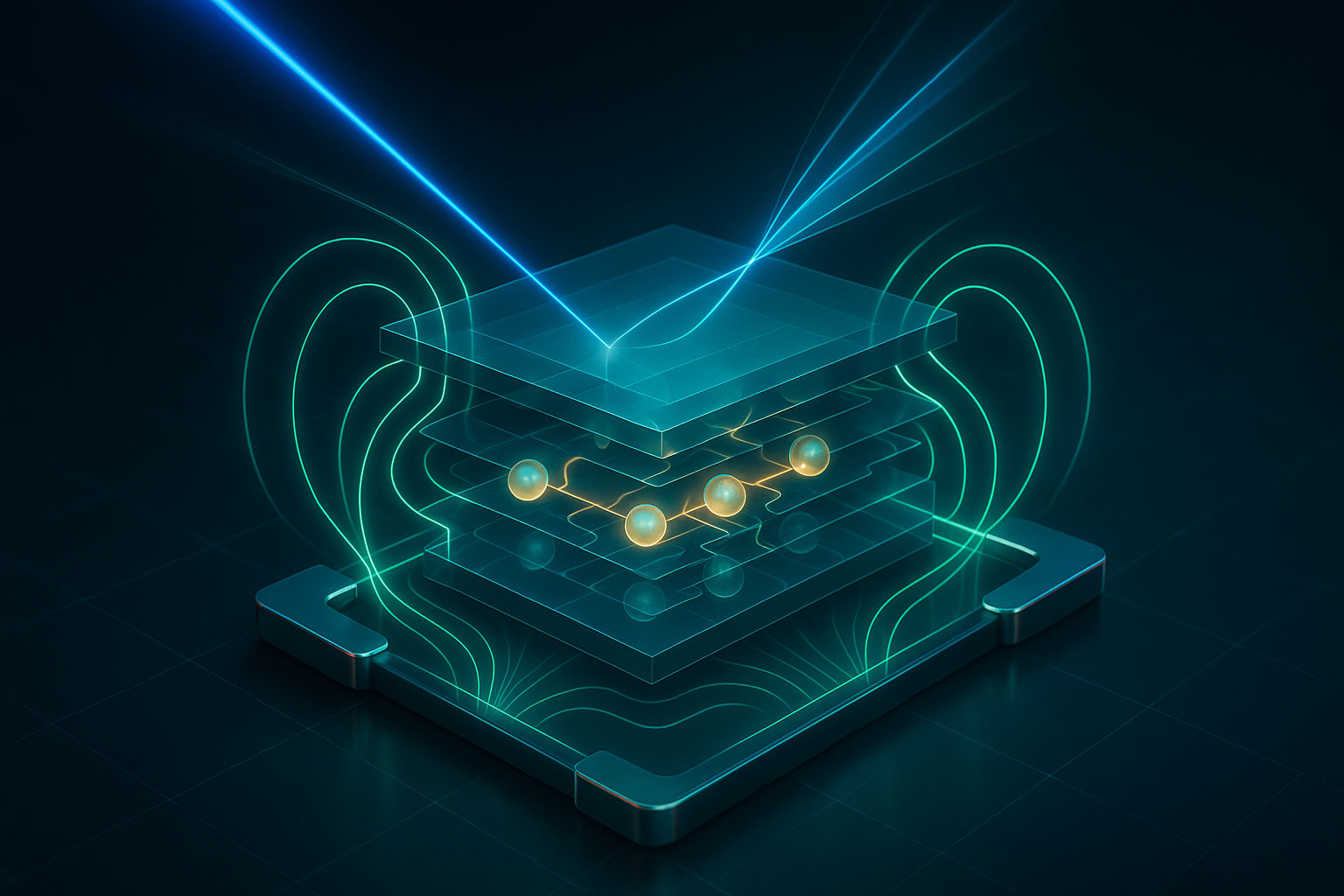 Artistic impression of a 2D crystal inside a chip, where light (in blue) couples to the electric field of the crystal (in green). Credit: TU Delft / Nijmegen University
A newly studied ferroelectric crystal can tune and manipulate ultraviolet and blue light in ways that could transform integrated photonics.
Scientists from TU Delft and Radboud University in the Netherlands have identified an unusual property in the two-dimensional ferroelectric material CuInP₂S₆ (‘CIPS’). Their work shows that this crystal can steer and modify blue and ultraviolet light in ways rarely seen in other materials.
Because ultraviolet light plays a central role in advanced semiconductor manufacturing, high-resolution microscopy, and emerging optical communication systems, gaining better control of this part of the spectrum on microchips is increasingly important. As reported in the journal Advanced Optical Materials, the researchers demonstrate that CIPS can be incorporated directly onto chips, suggesting new possibilities for integrated photonics.
 PhD candidate Houssam El Mrabet Haje. Credit: TU Delft
A special kind of ferroelectric
CIPS belongs to a class of atomically layered ferroelectric materials. In these crystals, a built-in electric dipole forms because copper ions shift slightly within the structure. These ions are also able to move within the lattice, giving the material unusual electrical behavior. What makes CIPS especially distinctive is that the motion of these copper ions changes depending on the thickness of the crystal layer.
Researchers from Delft and Nijmegen found that this thickness dependent ferroelectric behavior directly affects the material’s refractive index, which describes how strongly a material slows and bends light passing through it. As the thickness of the crystal changes, so does the way it interacts with light. First author of the paper, Houssam El Mrabet Haje: “Going from bulk material to a layer of only tens of nanometers thick, the refractive index of CIPS changed by almost 25% in an unexpected, ‘anomalous’ way.”
Potential game-changer
The team also discovered an extreme optical property known as giant birefringence in the blue to ultraviolet portion of the spectrum. In birefringent materials, light traveling in different directions experiences different refractive indices. In CIPS, light moving perpendicular to the crystal layers behaves very differently from light moving along the layers.
Near wavelengths of about 340 nanometers in the near ultraviolet region, this difference reaches roughly 1.24. According to the researchers, this is the largest intrinsic birefringence reported so far at these wavelengths. Houssam: “This means that CIPS can act as an extremely powerful polarization and phase control element for short-wavelength light, without needing complicated nanostructuring. It confirms CIPS as a potential game-changer for many photonics applications.”
Choosing the right thickness
Although the researchers are still working to fully understand the phenomenon, they propose a new mechanism that may explain how CIPS interacts with light. Light carries oscillating electric and magnetic fields, and in most materials those fields mainly interact with electrons.
 Associate Professor Mazhar N. Ali, head of the Ali Lab at the Quantum Nanoscience Department of TU Delft. Credit: TU Delft
In CIPS, however, the fields also interact with the internal electric field created by displaced copper ions within the crystal. Because the configuration of those ions changes with crystal thickness, the strength of the light interaction changes as well. Houssam: “Light carries oscillating electric and magnetic fields; in CIPS, these fields couple not just to electrons, but also to the internal electric field created by the displaced copper ions. What makes CIPS so special is that the copper ion configuration, and therefore the material’s coupling with light, changes with crystal thickness. This makes it possible to tune the optical response simply by choosing the right CIPS thickness.”
New tools for sculpting light
Mazhar N. Ali, the principal investigator of the project, notes that the implications may extend beyond this single material. Mazhar N. Ali, principal investigator for the project: “CIPS is not the only material with such properties. Our discovery of a mechanism where ferroelectric polarization and mobile ions work together to shape light–matter interactions may extend to other ferroelectric materials.”
This suggests a broader design strategy for future photonic materials. By engineering crystals that contain mobile ions capable of altering internal electric fields, scientists may be able to tailor how materials interact with light across a wide range of wavelengths.
Tunable UV/blue components
The research also hints at potential applications in next-generation optical technologies. Houssam concludes, “With further work, CIPS-based structures could underpin tunable UV/blue components for integrated electro-optics – controlled not just by electrons, but by the motion of ions inside a crystal only billionths of a meter thick.”
If these systems can be developed further, materials like CIPS could play an important role in the miniaturization of photonic devices that operate with ultraviolet and blue light, enabling more precise control of light on microscopic chips.
Reference: “Anomalous Refractive Index Modulation and Giant Birefringence in 2D Ferrielectric CuInP2S6” by Houssam El Mrabet Haje, Roald J.H. van der Kolk, Trent M. Kyrk, Sergii Grytsiuk, Malte Rösner and Mazhar N. Ali, 17 November 2025, Advanced Optical Materials.
DOI: 10.1002/adom.202502291
The authors acknowledge the support from the Dutch Research Council (NWO) under the 2023 VIDI Award VI.Vidi.223.089, as well as the Kavli Foundation under the Kavli Institute Innovation Award (KIIA) (LS-2023-GR-14-2778).
Never miss a breakthrough: Join the SciTechDaily newsletter.
Follow us on Google and Google News.


















 English (US) ·
  French (CA) ·
  French (FR) ·