

PROTECT YOURSELF with Orgo-Life® QUANTUM TECHNOLOGY
Orgo-Life the new way to the future Advertising by Adpathway Scientists have made light do something long thought impossible—mimicking the quantum Hall effect, a Nobel Prize–winning phenomenon usually seen only in electrons. (Artist’s concept.) Credit: SciTechDaily.com
Physicists have recreated the Nobel Prize–winning quantum Hall effect using light, revealing that photons can follow the same strange quantum rules once thought exclusive to electrons.
In the late 1800s, scientists discovered what is now known as the Hall effect. It occurs when an electric current passes through a material while a magnetic field is applied at a right angle to the current. Under these conditions, a voltage appears across the material in the sideways direction.
The reason is straightforward. The magnetic field pushes negatively charged electrons toward one side of the conductor. As electrons gather along that edge, they create a buildup of negative charge, while the opposite side becomes positively charged. This separation produces a measurable voltage across the strip.
Researchers have relied on this voltage difference for many decades. It provides a precise way to measure magnetic fields and to determine material doping levels, that is, the addition of a tiny, controlled amount of impurity to a pure material to change how it conducts electricity.
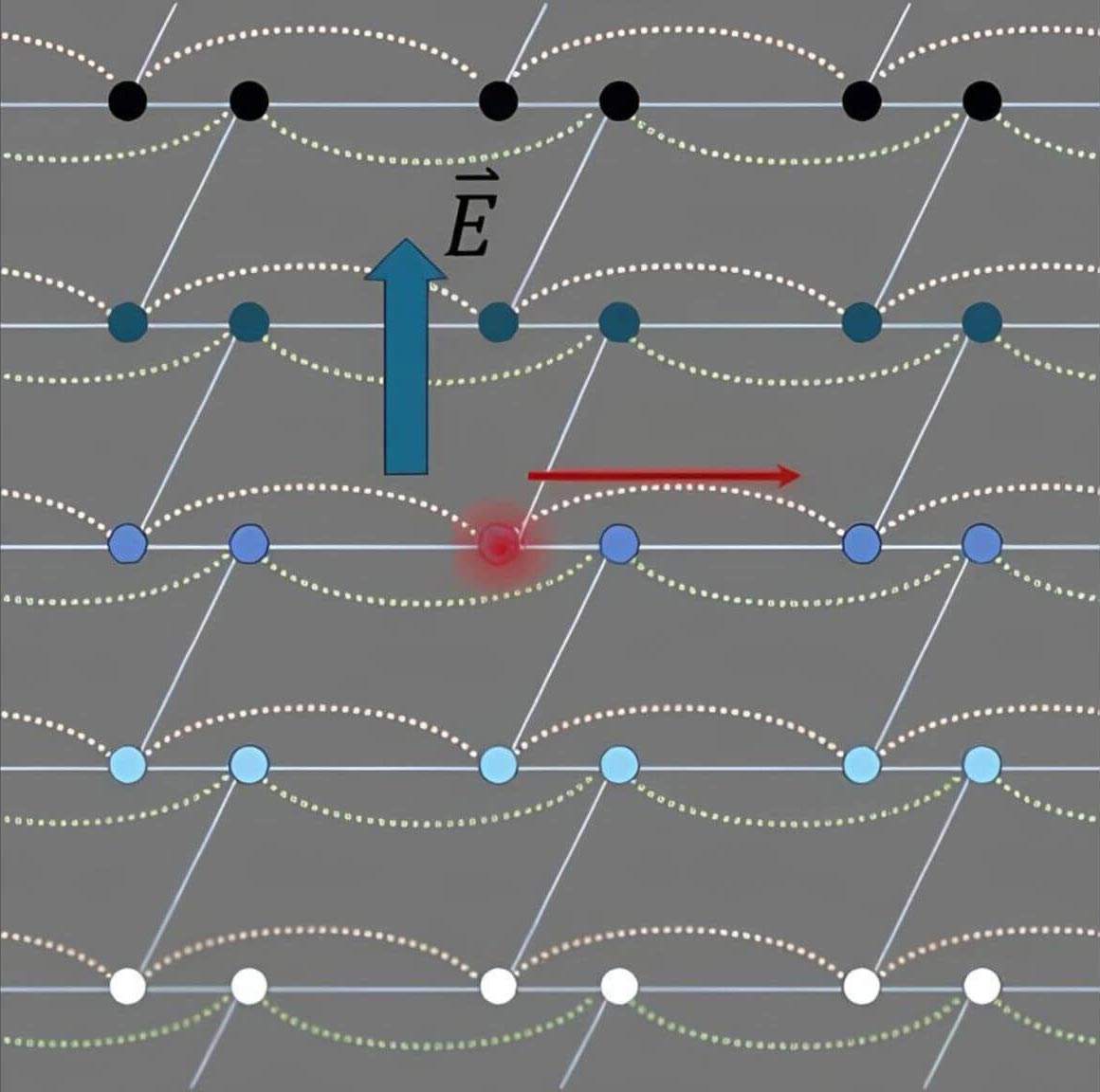 Illustration of the transverse drift quantified with photons. Credit: Philippe St-Jean
The Quantum Hall Effect and Nobel Prize Discoveries
In the 1980s, physicists studying extremely thin conductors at ultra-low temperatures made an unexpected discovery. When very strong magnetic fields were applied to these materials, which can be as thin as a sheet of paper, the sideways voltage did not increase smoothly. Instead, it rose in sharply defined steps.
These flat regions, called plateaus, turned out to be universal. Their values do not depend on the material’s composition, shape, or microscopic imperfections. Instead, they are determined only by fundamental constants of nature: the electron charge and the Planck constant.
This phenomenon became known as the quantum Hall effect. Its importance in physics was quickly recognized and ultimately led to three Nobel Prizes in Physics: in 1985, for the discovery of the quantum Hall effect, in 1998 for the discovery of the fractional quantum Hall effect, and in 2016 for the discovery of topological phases of matter.
Why Recreating the Effect With Light Was Difficult
Until now, the quantum Hall effect had been observed mainly in electrons. Because electrons carry electric charge, they respond to electric and magnetic fields. Photons, which are particles of light, do not have electric charge and therefore do not react to those forces.
That difference made it extremely difficult to reproduce the quantum Hall effect using light.
Researchers Observe Quantized Drift of Light
An international team of scientists has now achieved what once seemed impossible. They have observed a quantized sideways drift in light itself. Their results were published in the journal Physical Review X.
“Light drifts in a quantized manner, following universal steps analogous to those seen with electrons under strong magnetic fields,” explained Philippe St-Jean, a physics professor at Université de Montréal who co-authored the study.
According to St-Jean, the discovery could have far-reaching consequences. In metrology, the science of precision measurement, optical systems might one day serve as a universal standard that complements or even replaces electronic systems.
Implications for Measurement and Global Standards
The quantum Hall effect already plays a critical role in modern measurement science.
“Today, the kilogram is defined on the basis of fundamental constants using an electromechanical device that compares electric current to mass,” St-Jean explained. “For this current to be perfectly calibrated, we need a universal standard for electrical resistance.
“The quantum Hall plateaus give us exactly that. Thanks to them, every country in the world shares an identical definition of mass, without relying on physical artifacts.”
St-Jean suggests that the ability to control the flow of light in quantized steps could open new opportunities not only in metrology but also in fields such as quantum information processing. It could even help pave the way toward more resilient quantum photonic computers.
Small departures from perfect quantization could also prove useful. Even tiny deviations may reveal environmental disturbances, which could lead to extremely sensitive new types of sensors.
Engineering the Future of Quantum Photonic Devices
“Observing a quantized drit of light is uniquely challenging, for photonic systems are inherently out of equilibrium,” St-Jean noted. “Unlike electrons, light demands precise control, manipulation, and stabilization.”
The experiment developed by the research team required sophisticated experimental engineering. Their work points to new possibilities for designing advanced photonic devices that could transmit and process information in powerful new ways.
Reference: “Quantized Hall Drift in a Frequency-Encoded Photonic Chern Insulator” by A. Chénier, B. d’Aligny, F. Pellerin, P.-É. Blanchard, T. Ozawa, I. Carusotto and P. St-Jean, 5 February 2026, Physical Review X.
DOI: 10.1103/2dyh-yhrb
Never miss a breakthrough: Join the SciTechDaily newsletter.
Follow us on Google and Google News.





















 English (US) ·
  French (CA) ·
  French (FR) ·