

 1 month ago
10
1 month ago
10
PROTECT YOURSELF with Orgo-Life® QUANTUM TECHNOLOGY
Orgo-Life the new way to the future Advertising by AdpathwaySupreme Court news: In a landmark ruling, the Supreme Court has said that a doctor’s liability for medical negligence does not end with his life, and legal heirs can be “impleaded” and “brought on record” in the matter.
A bench of Justices J K Maheshwari and Atul S Chandurkar was hearing civil appeals arising from a long-running medical negligence dispute that had moved through consumer forums, including the National Consumer Disputes Redressal Commission (NCDRC).
The matter pertained to an alleged botched-up eye surgery in 1990, following which a case was filed, but the doctor died during the pendency of the case.
“…we conclude that upon the death of the alleged medically negligent doctor, his/her legal heirs can be impleaded and brought on record. Consequently, the extent of liability will be determined based on the pleadings and evidence presented,” the Supreme Court bench said on May 4.
The main legal issue before the court was whether after the doctor’s death in 2009, during the pendency of the case, his legal heirs could be brought on record and the proceedings could continue, and if so, whether any eventual compensation could be recovered from the doctor’s estate.
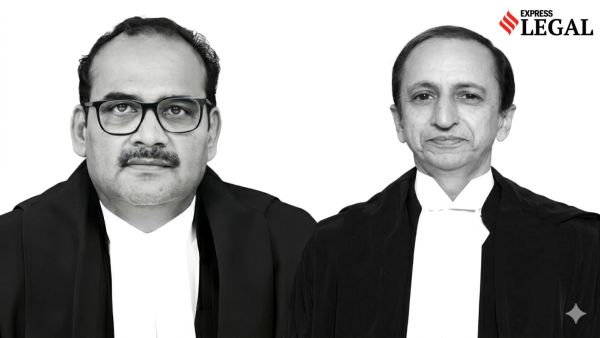 Justices J K Maheshwari and Atul S Chandurkar held that claims relating purely to personal injury that do not result in death generally do not survive the death of the wrongdoer.
Long-running dispute
- The case dates back to February 1990, when a woman suffering from severe pain in her right eye underwent surgery on the advice of a private doctor.
- According to the complaint, the procedure failed to bring relief and instead led to a gradual loss of vision in one eye, with the risk of affecting the other.
- Despite seeking treatment from multiple doctors in different cities, her condition did not improve.
- Her husband eventually filed a consumer complaint in August 1997, alleging medical negligence and seeking compensation of Rs 4.5 lakh for treatment expenses, loss of vision, and mental agony.
- In November 2003, the district consumer commission partly allowed the complaint, awarding Rs 2.6 lakh in compensation.
- However, the State Consumer Disputes Redressal Commission, Bihar, overturned this finding in December 2005, holding that negligence was not proved in the absence of expert medical evidence and that the treatment provided was within acceptable standards.
- The complainant then approached the NCDRC in revision.
- During the pendency of the proceedings, the doctor passed away in August 2009, triggering a fresh legal dispute over whether the case could continue against his legal heirs.
Core legal question
Before the Supreme Court, the central issue was whether a claim of medical negligence, essentially a personal tort, survives against the legal representatives of a deceased doctor, especially when no final liability had been determined at the time of his death.
In law, a tort (from the Latin tortum, meaning “wrong”) refers to a civil wrong or injury caused by one person to another, for which the law provides a remedy, usually in the form of damages or compensation.
Story continues below this ad
The doctor’s legal heirs (wife and son) argued that such claims are personal in nature and extinguish upon death under Section 306 (demands and rights of action of or against deceased survive to and against executor or administrator) of the Indian Succession Act, 1925. They relied on the long-standing principle that a personal right of action dies with the person.
On the other hand, the complainant argued that consumer protection law, being a beneficial statute, should allow continuation of proceedings, particularly where financial compensation is sought.
Court’s reasoning: What survives, what doesn’t
- The Supreme Court undertook an extensive examination of legal principles, including statutory provisions, common law doctrines, and the evolution of tort law in India.
- It clarified that procedural rules allowing substitution of parties do not automatically mean that a claim survives.
- Instead, the key question is whether the “right to sue” continues after the death of a party.
- The Supreme Court held that claims relating purely to personal injury that do not result in death generally do not survive the death of the wrongdoer.
- However, claims involving pecuniary loss, such as medical expenses or financial damage to the estate, can survive and be pursued against the estate of the deceased.
- In effect, while personal liability may end with death, financial liability tied to the estate may still be enforced.
Consumer law, legislative intent
The Supreme Court bench also examined provisions of the Consumer Protection Act, 1986, which allow for the substitution of parties in case of death. The court noted that while the law enables proceedings to continue, it does not override the substantive limitations imposed by succession law.
At the same time, the Supreme Court recognised that consumer protection legislation is meant to provide effective remedies and should not be interpreted in a way that defeats legitimate claims prematurely.
Story continues below this ad
No finding on negligence yet
- The Supreme Court did not decide whether the doctor was negligent.
- That issue remains open and will be determined on the merits by the appropriate forum.
- The ruling is limited to clarifying that the case can continue, and that any compensation, if eventually awarded, can be recovered from the estate of the deceased doctor, not from his legal heirs personally.
Wider implications
The judgment is expected to have far-reaching implications beyond medical negligence cases. The Supreme Court noted that the principles laid down would apply to other tort claims as well, including those arising from accidents and civil wrongs.
By distinguishing between personal claims and those affecting the estate, the top court has provided much-needed clarity on a long-standing legal issue.
For litigants, the ruling ensures that cases do not automatically collapse due to the death of a party. For legal heirs, it offers protection by limiting liability strictly to the assets inherited.
With this decision, the Supreme Court has not only addressed a decades-old dispute but also set a clear precedent on how courts should handle the survival of legal claims in similar cases going forward.



















 English (US) ·
  French (CA) ·
  French (FR) ·